One platform.
Eight revenue lines.
Zero compromise.
Vexo.Exchange is a full-stack digital-asset exchange covering spot trading, futures, P2P fiat on-ramps, launchpad, staking, fixed-yield investments, an NFT marketplace and an affiliate engine — all behind a single login, a single wallet, and a Rust-powered matching engine that settles trades in microseconds. This walkthrough captures the user-facing surface, end to end, rendered in our flagship Aurora theme — one of eight curated palettes shipped with the trading terminal.
Front Door — the public surface
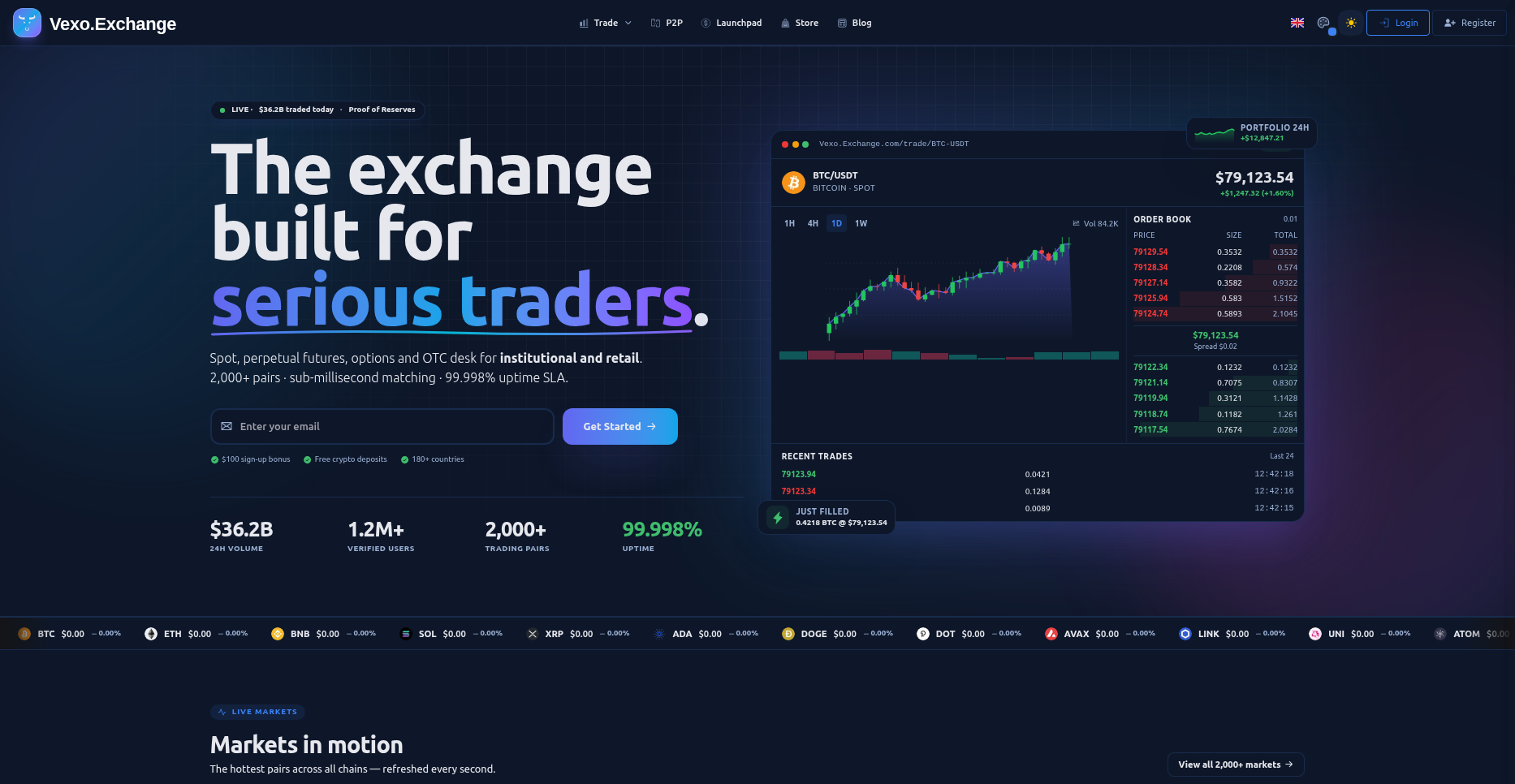
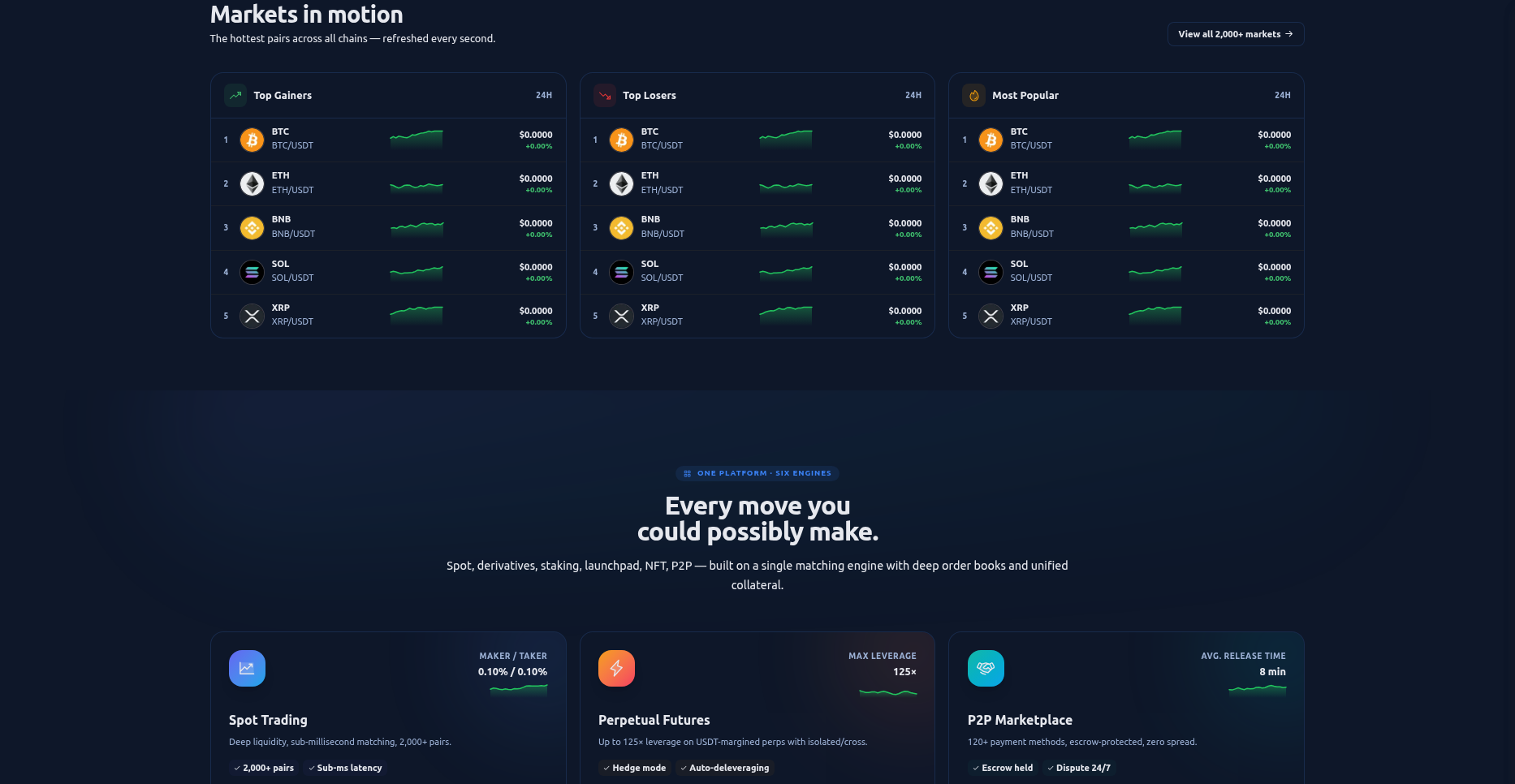
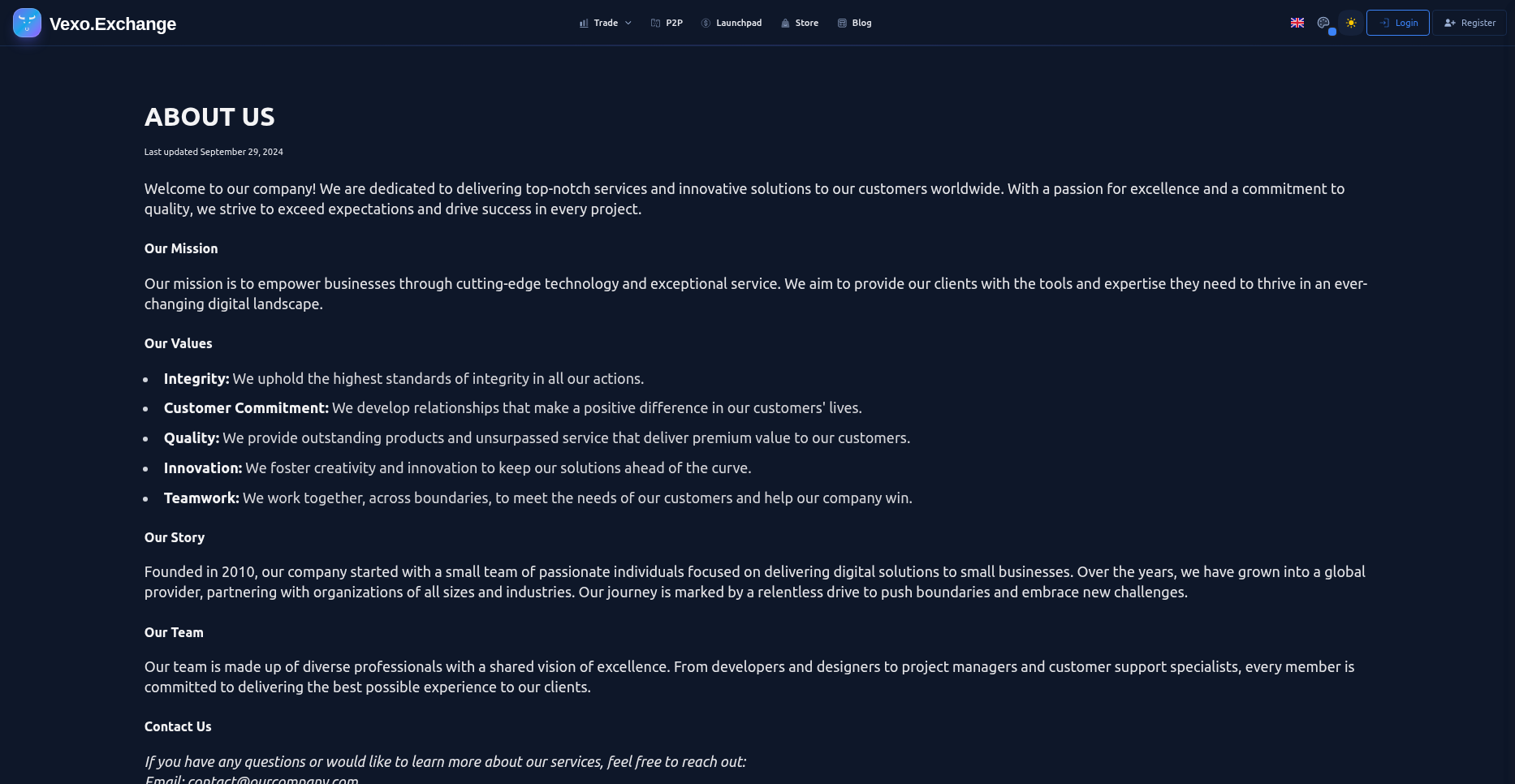
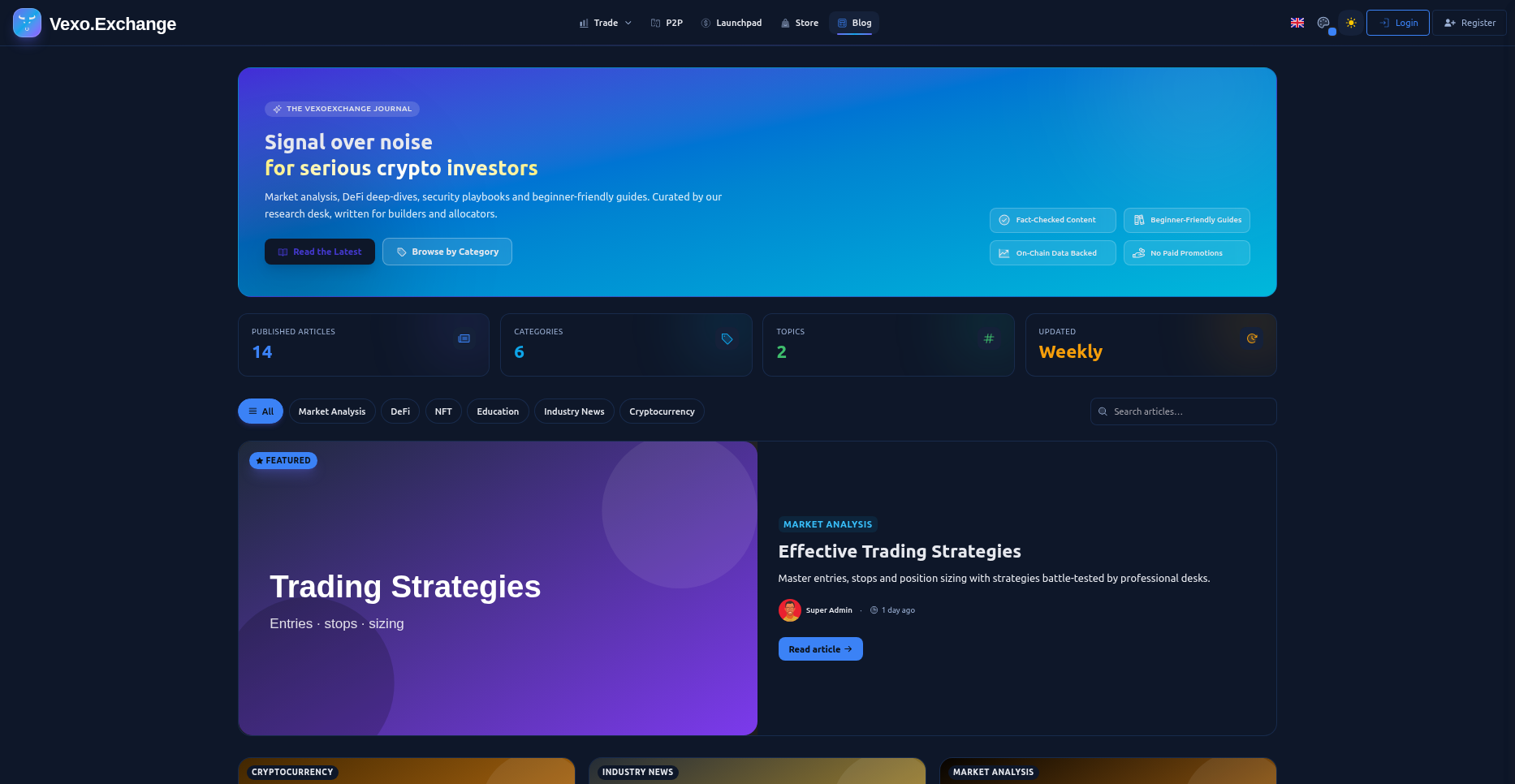
Before a visitor signs up, the marketing surface has to do three jobs at once: establish credibility, show range, and prove the product is alive. The home page leads with the flagship value props and an at-a-glance market ticker; the about page makes the team, mission and licensing posture explicit; and the public blog is where we publish weekly market reports — proof that there's a human, accountable operation behind the URL.
Onboarding — three taps to a funded account
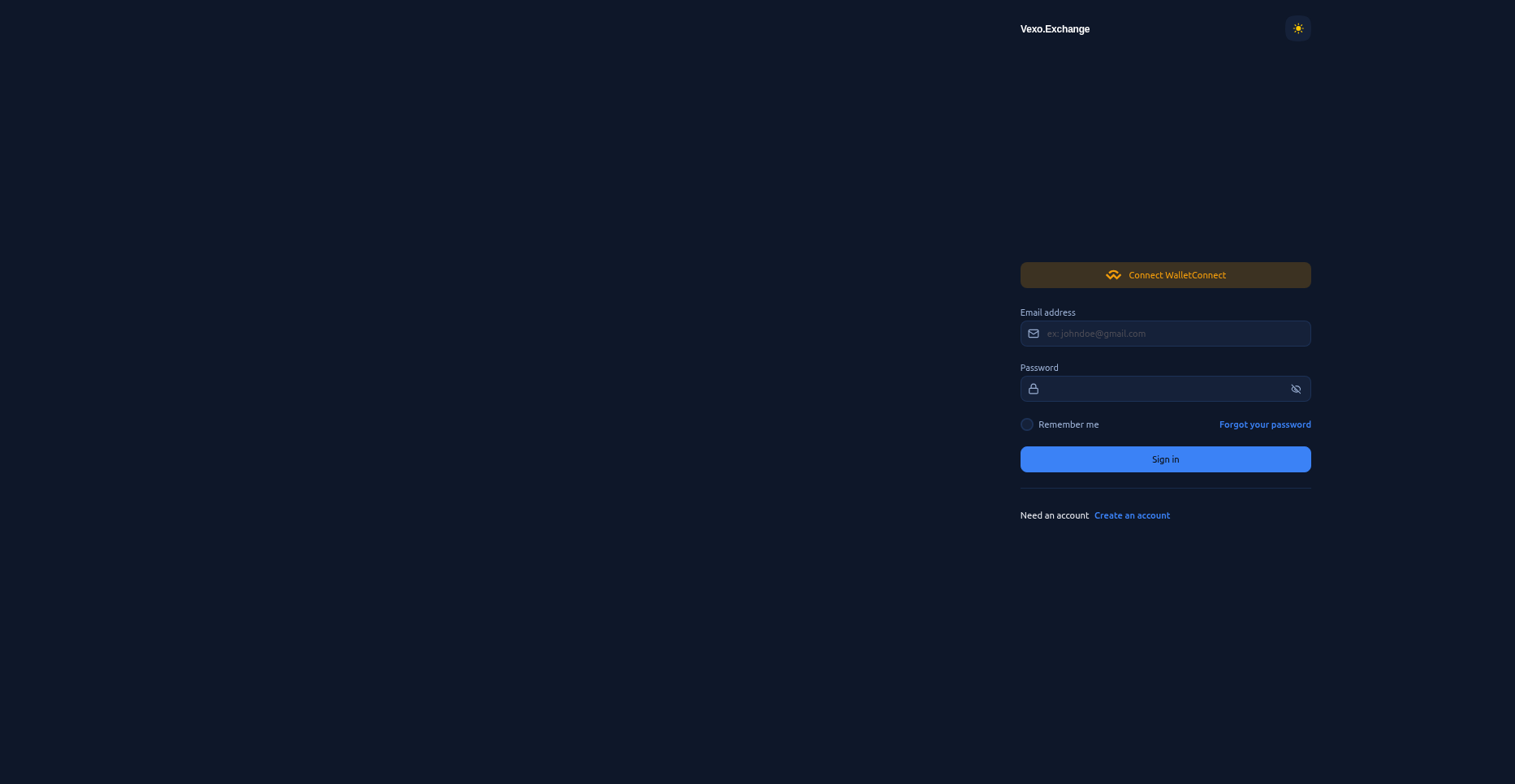
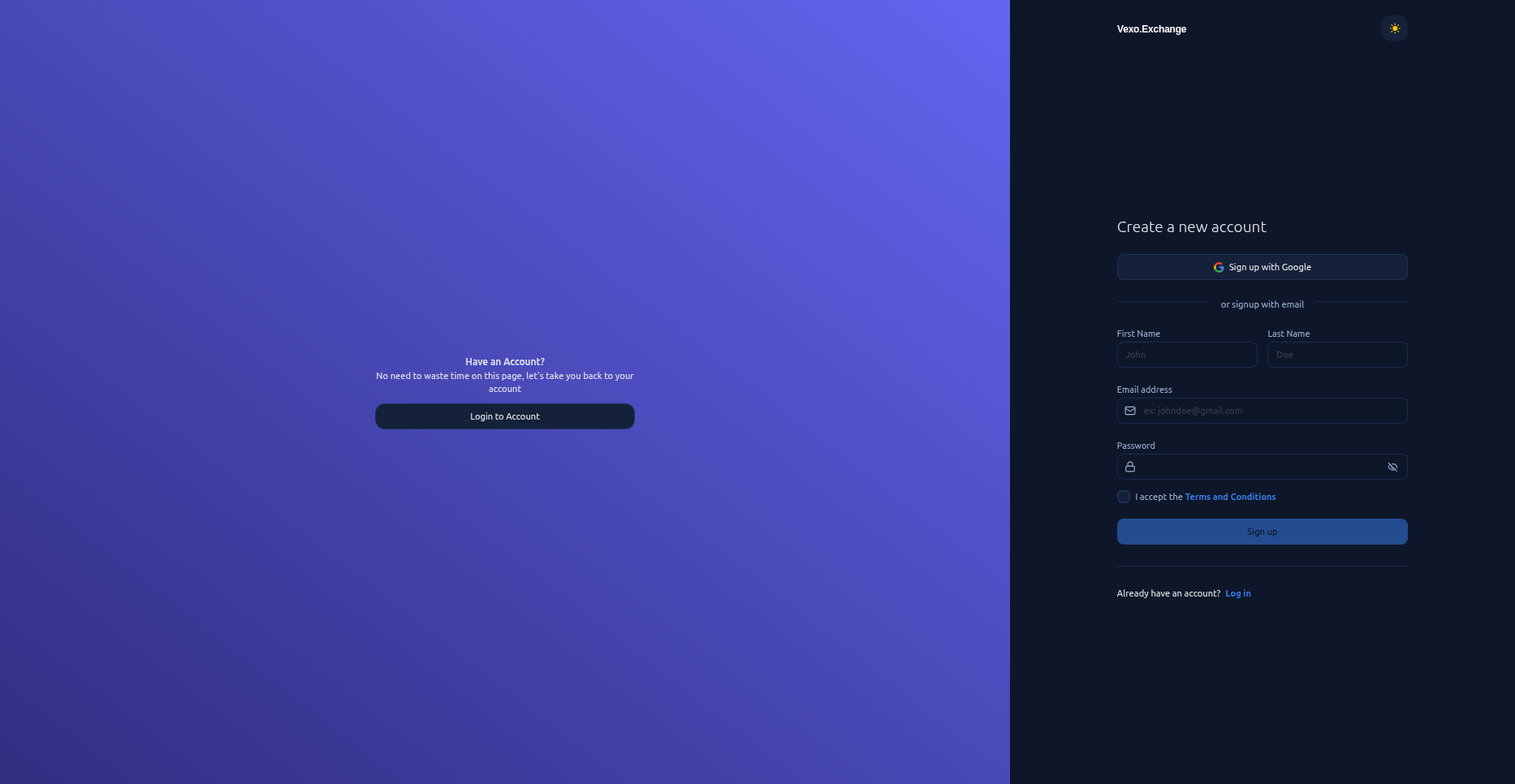
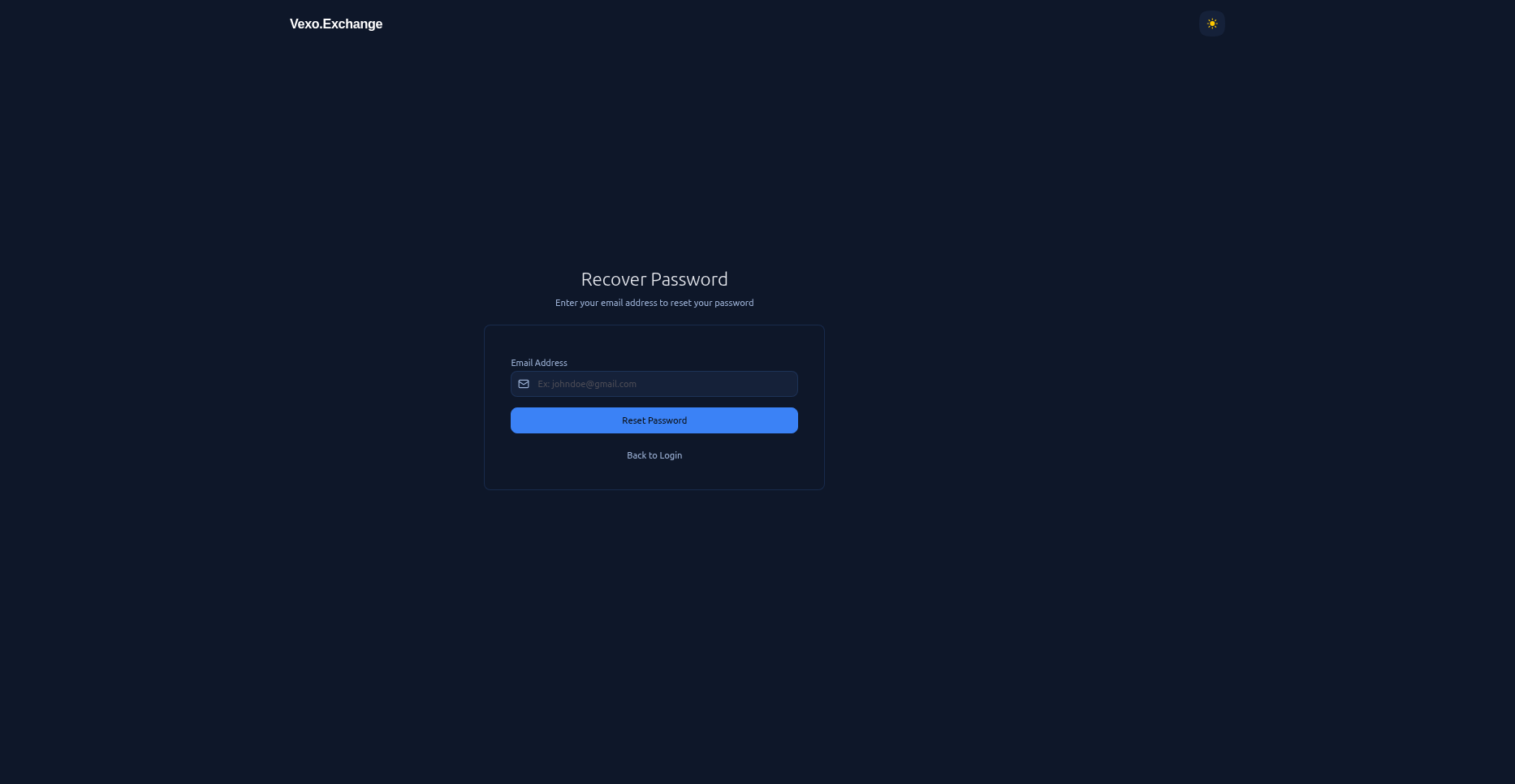
The entire onboarding loop — sign-up, sign-in, password recovery — is a single Wallet-Connect-aware screen pair. Email/password is the default; users who already carry a self-custody wallet can authenticate by signature instead of typing. Every form is reCAPTCHA-protected and routes through the same centralised auth store that drives 2FA, email verification and the API-key console downstream.
Identity & Account — the user's home
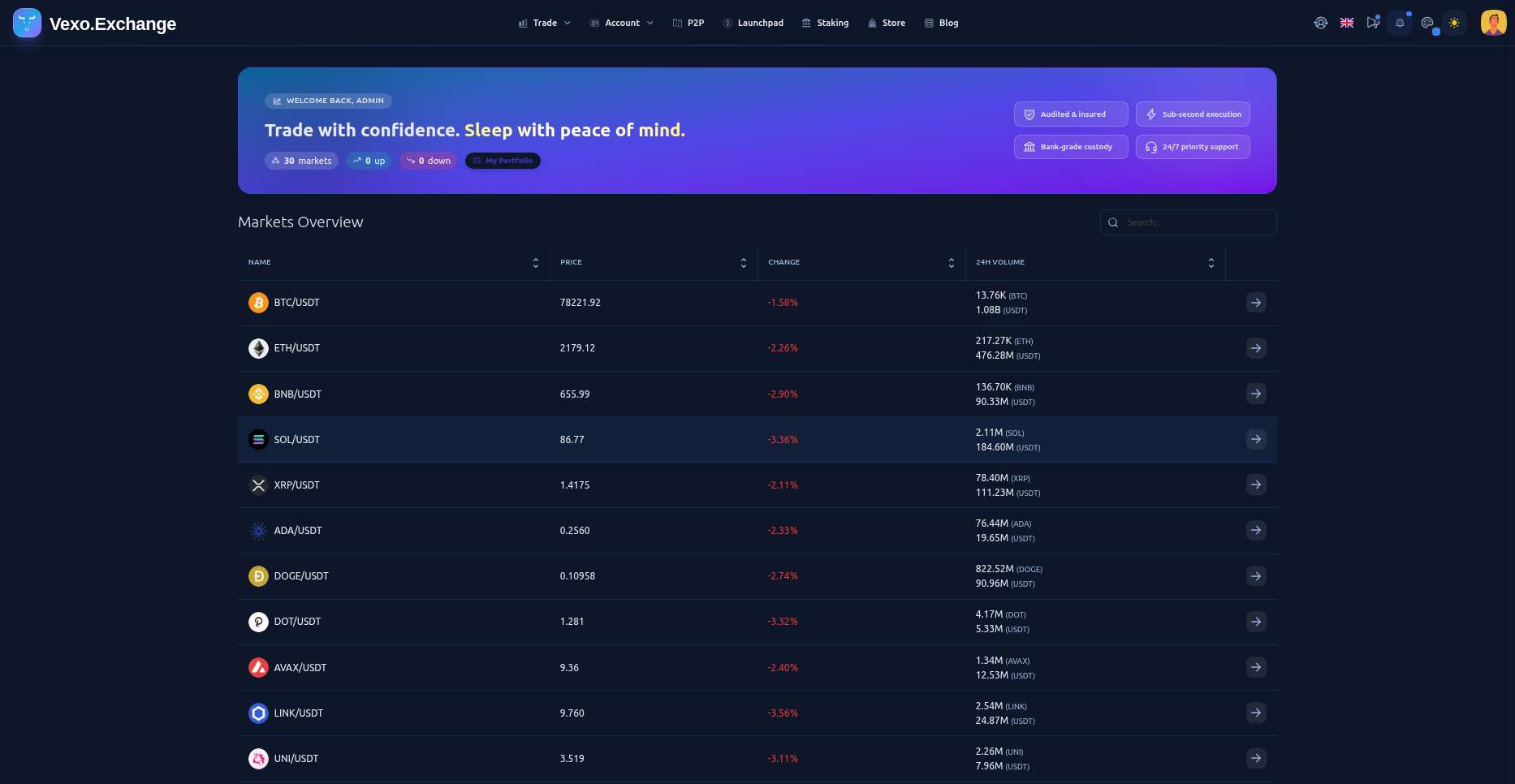
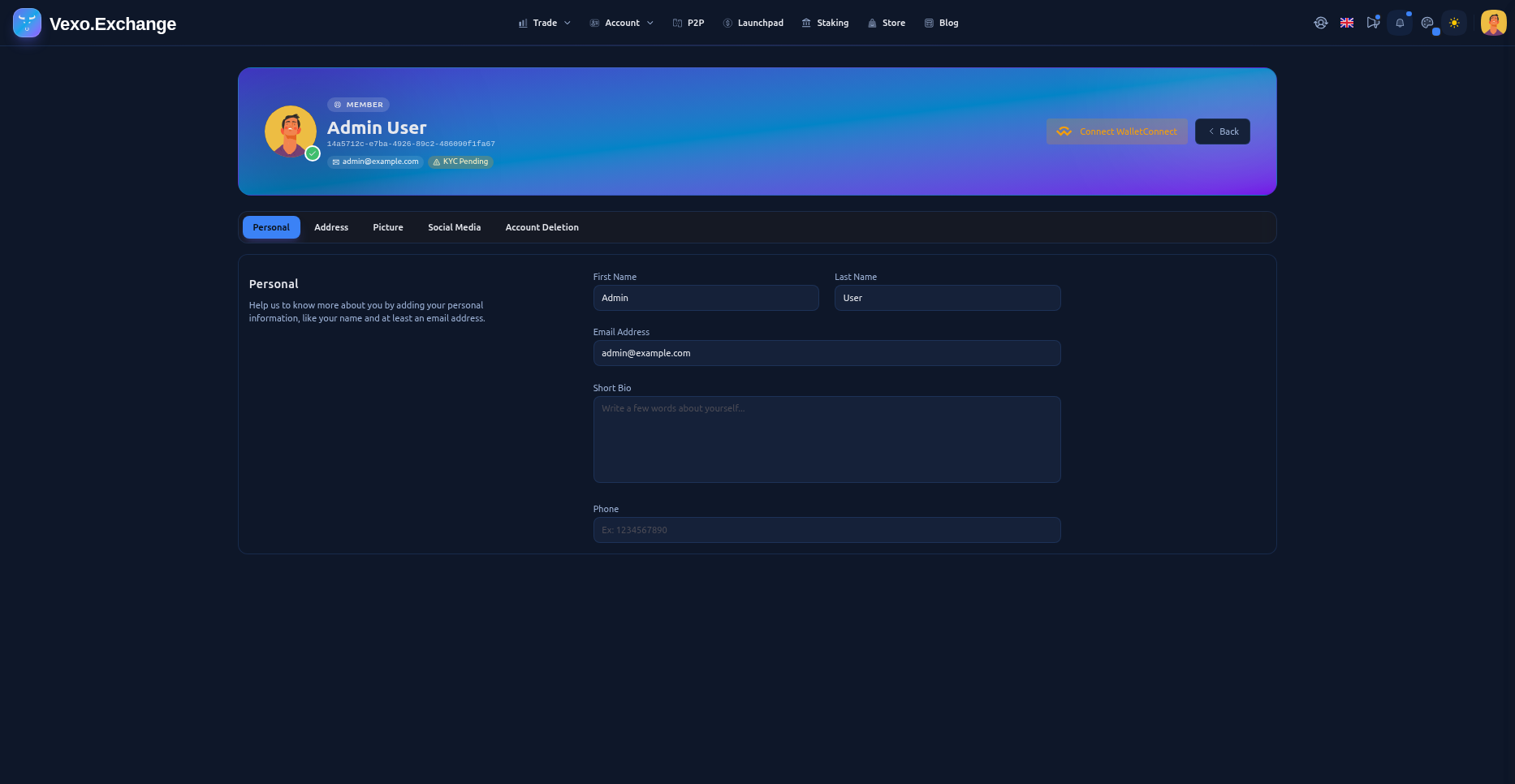
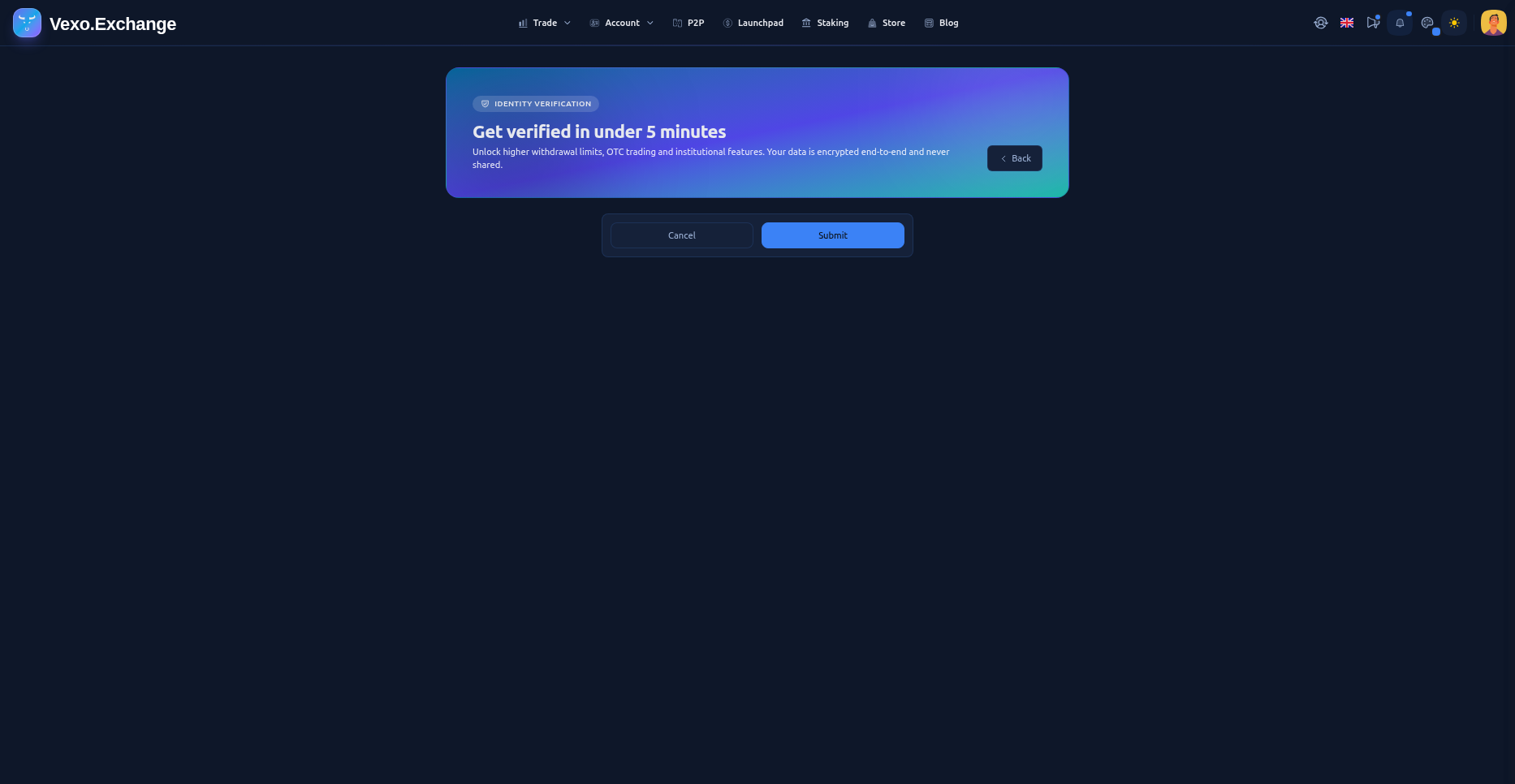
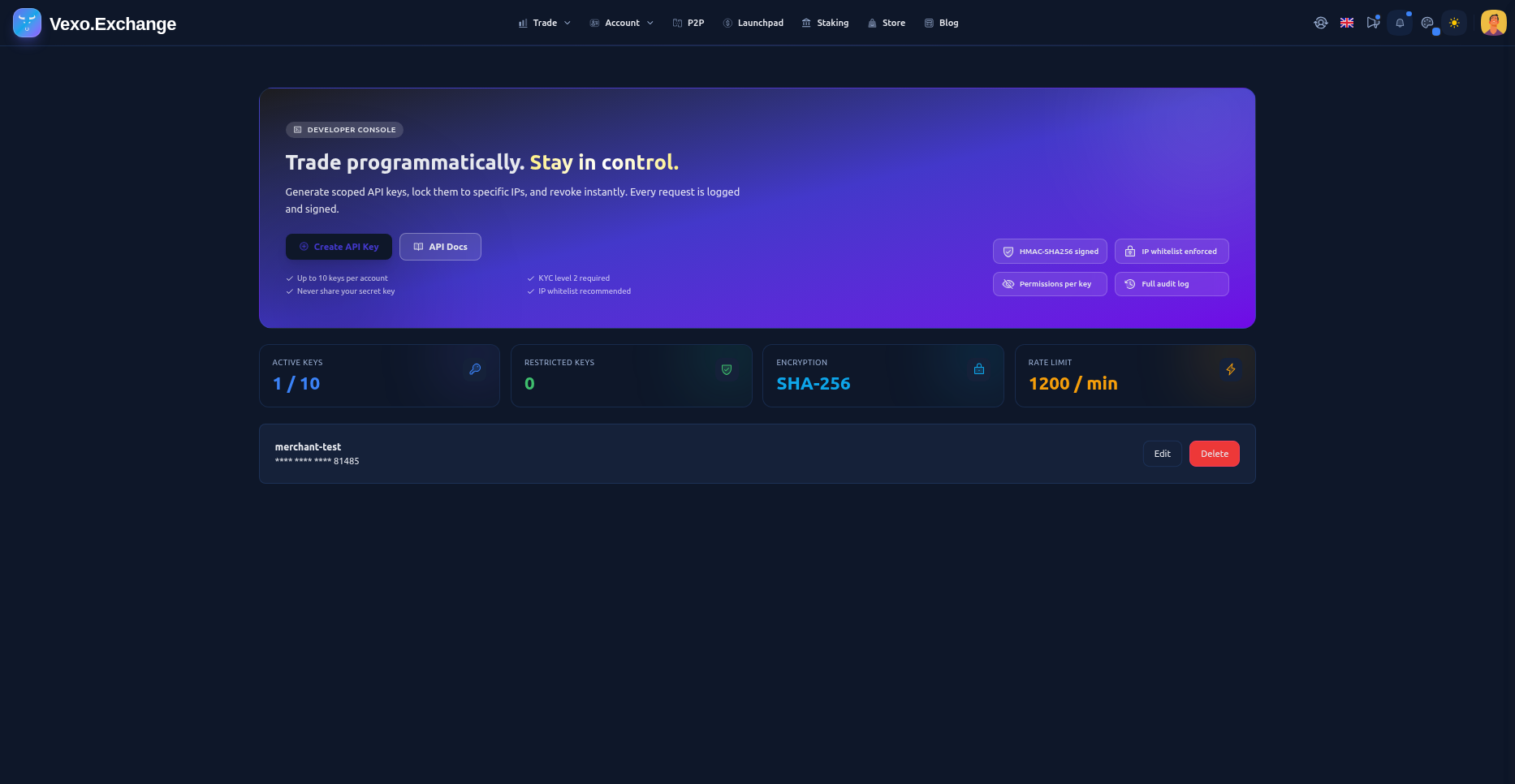
Once authenticated, the user lands on a personal dashboard that rolls up every product line into a single view. The profile, KYC and API-key screens hang off the same shell — meaning compliance, security and developer access share one navigation model. One account, every surface.
Treasury & Wallets — the rails
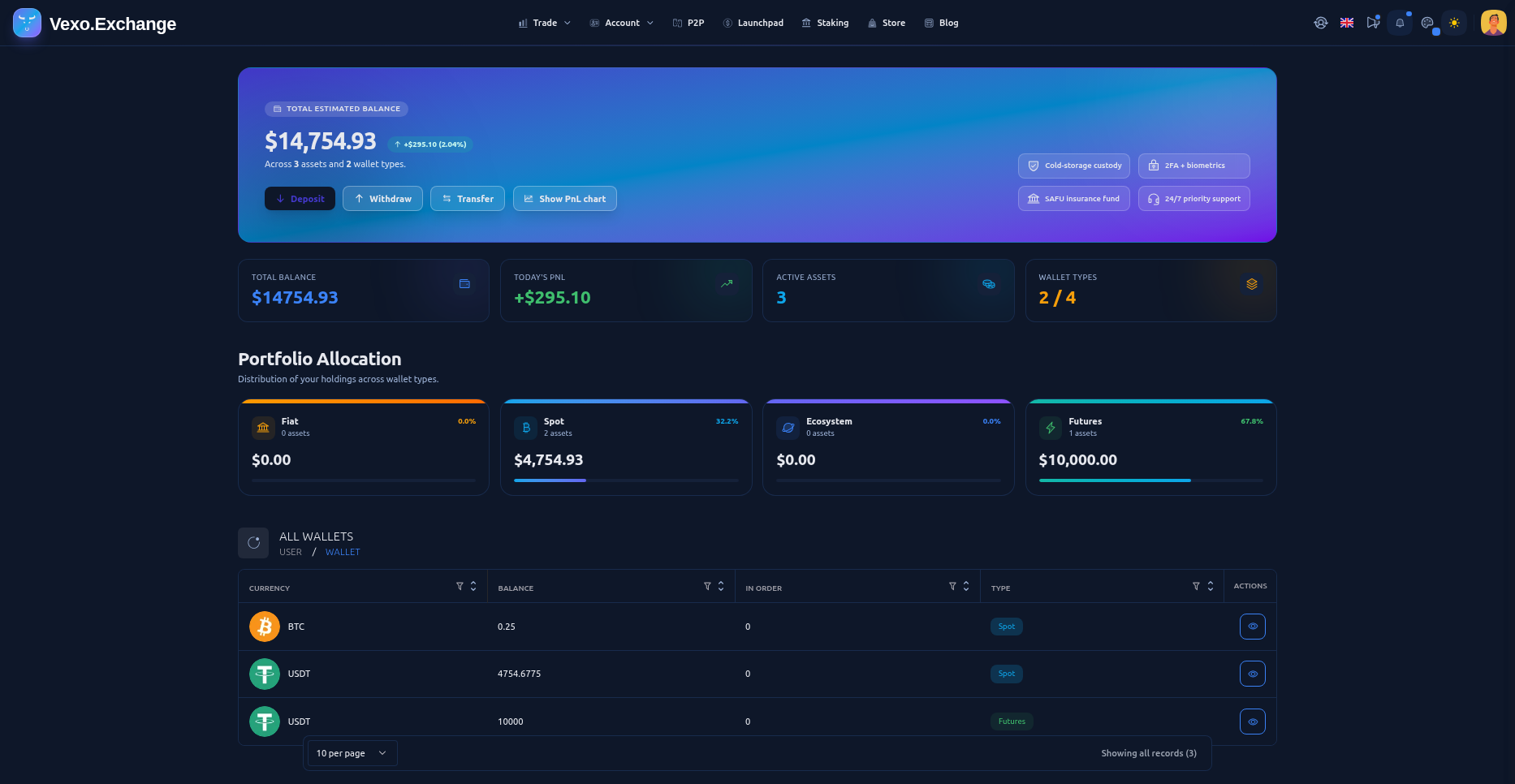
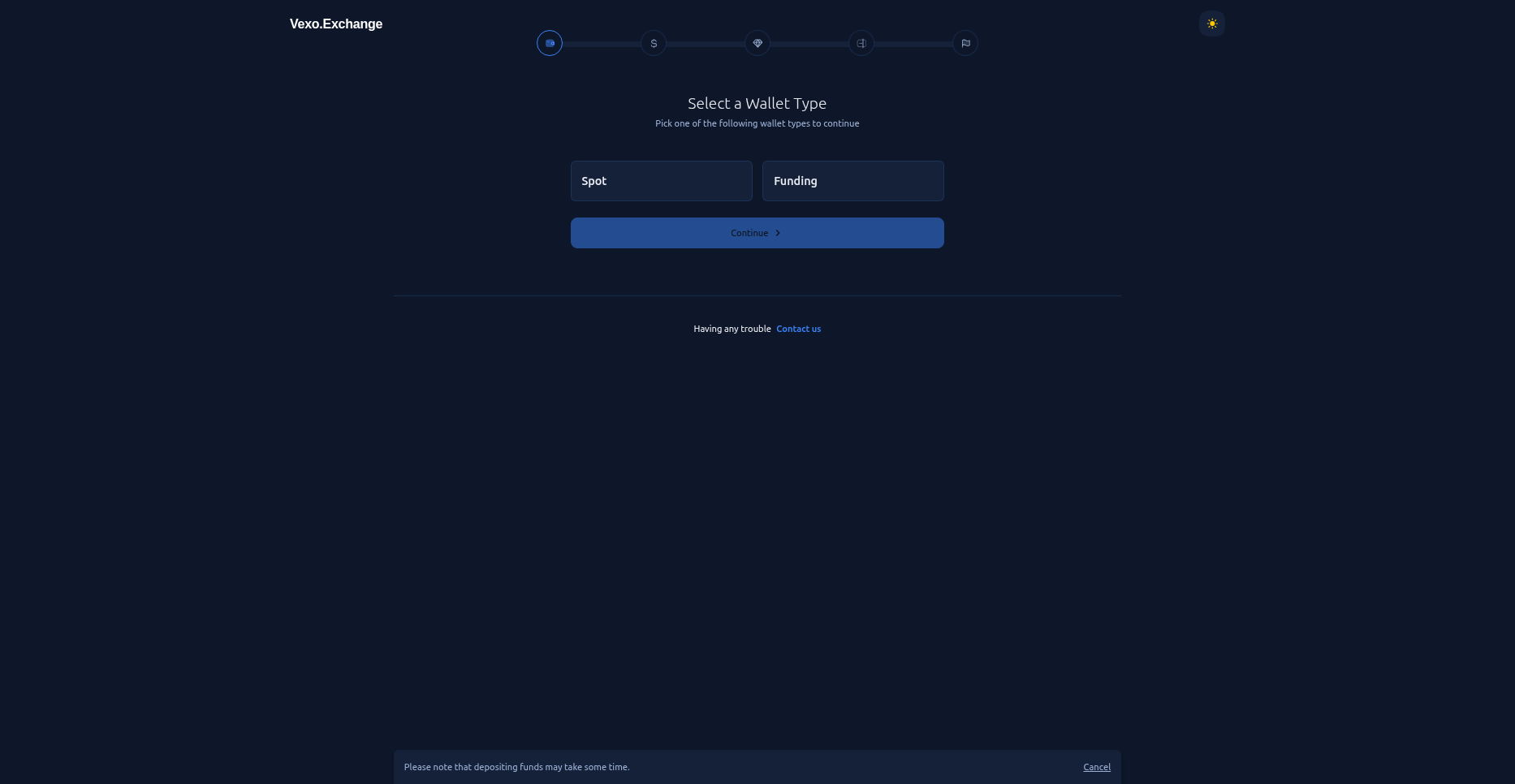
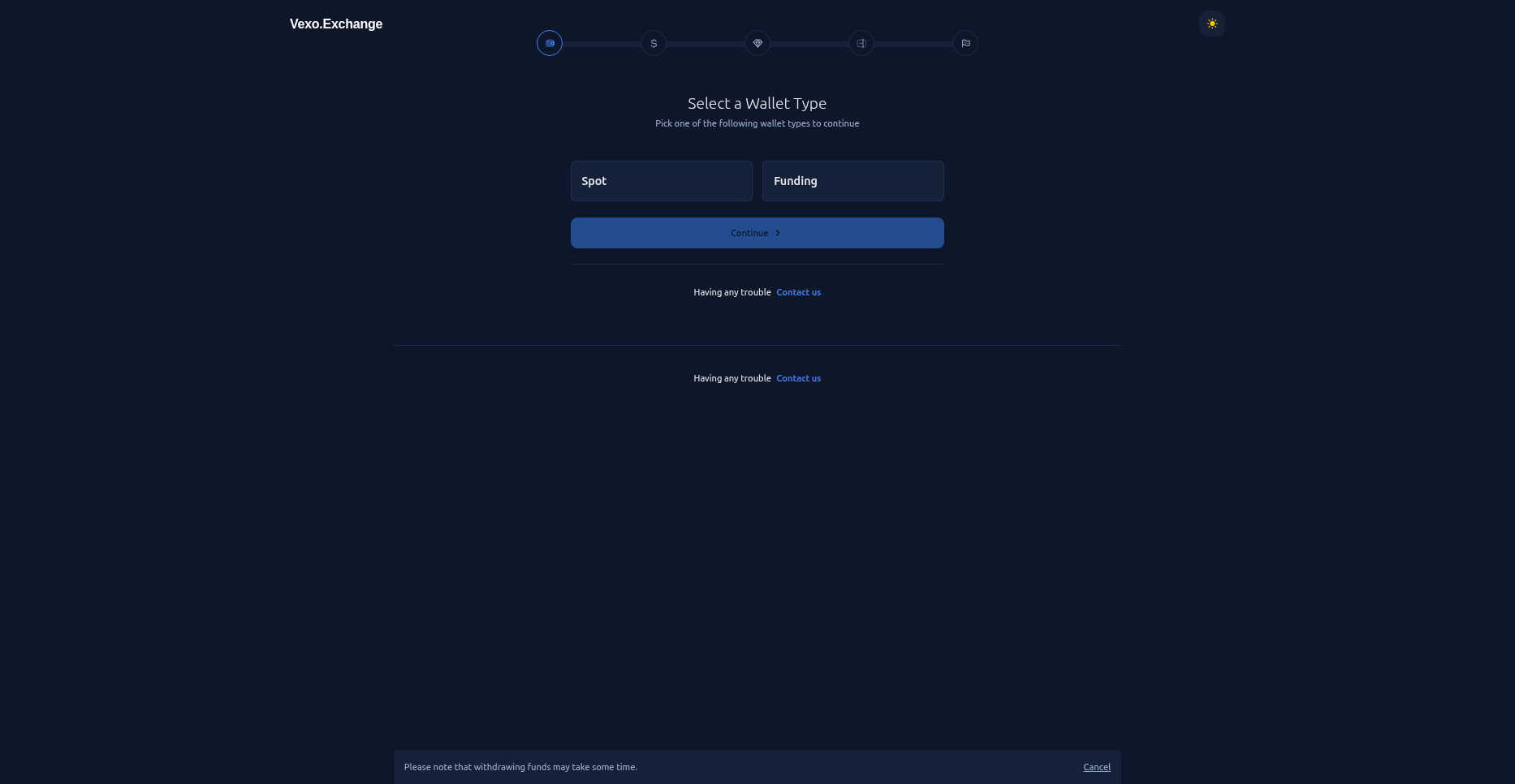
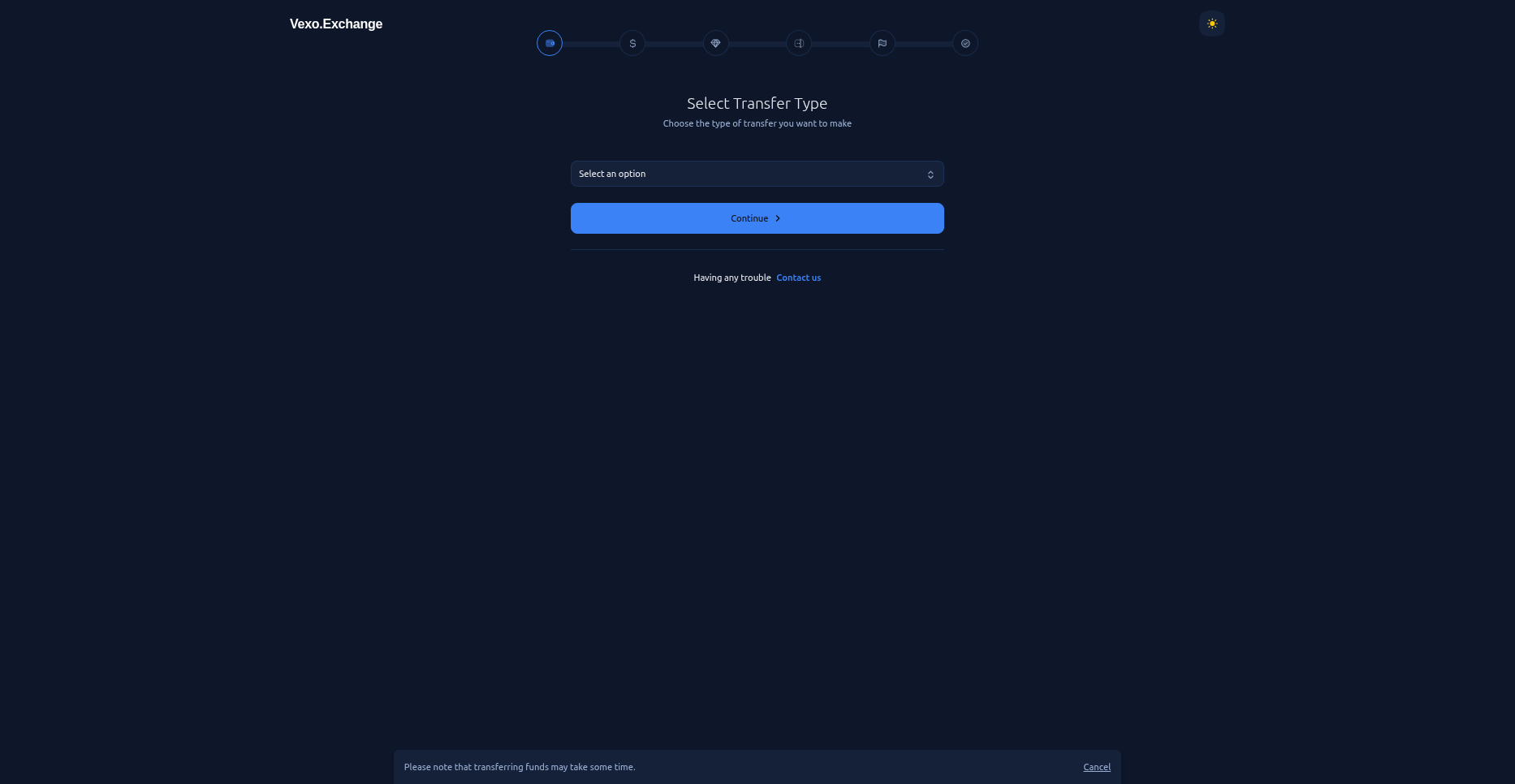
Every fund movement flows through a single multi-chain ECO wallet system: custody is segmented by purpose (spot, funding, futures margin) and every transfer is ledgered, reversible and auditable. The deposit wizard supports crypto, card and fiat on-ramp partners; the withdraw flow enforces 2FA, KYC tier and whitelist; internal transfer is instant and free.
Mercat — the flagship spot engine
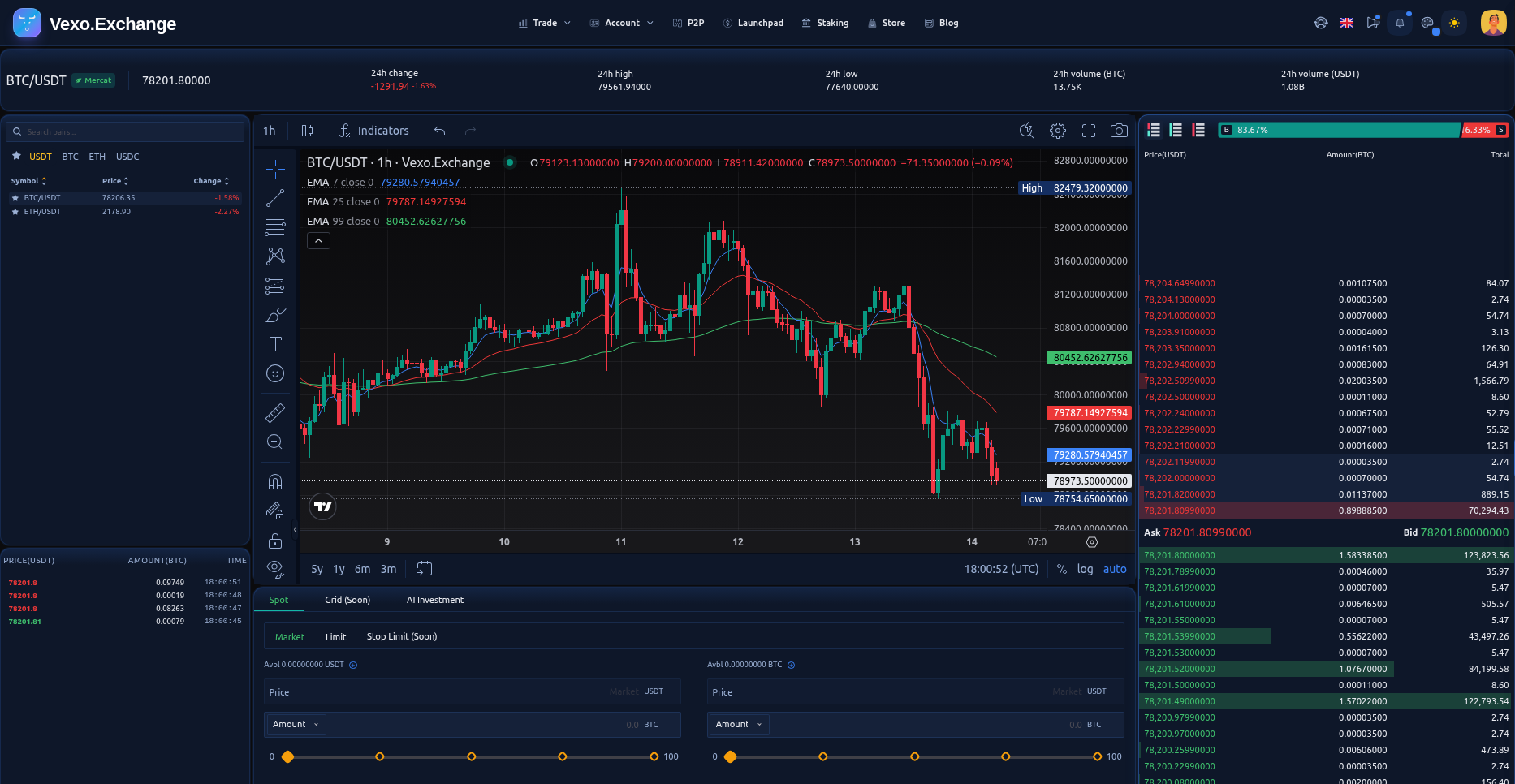
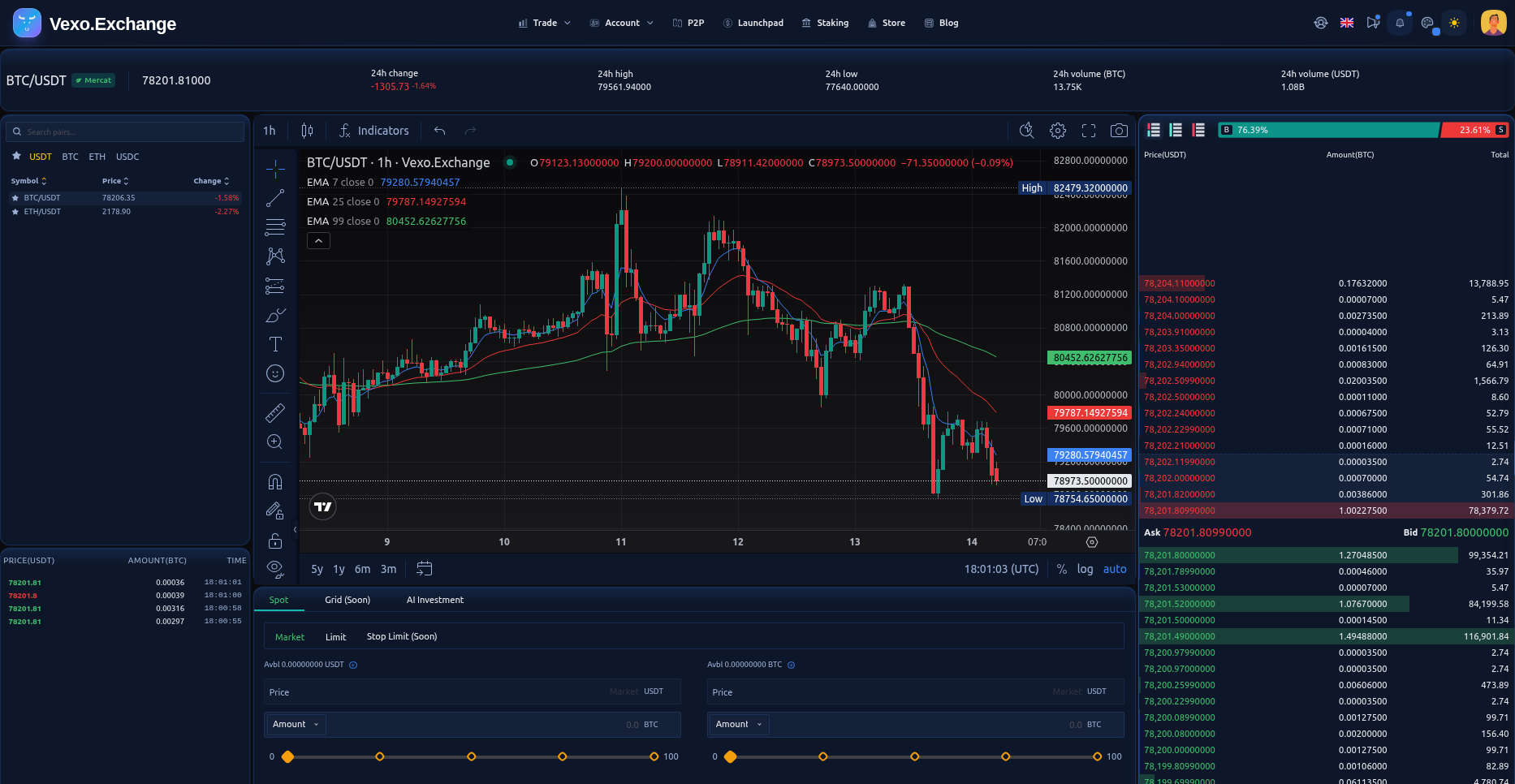
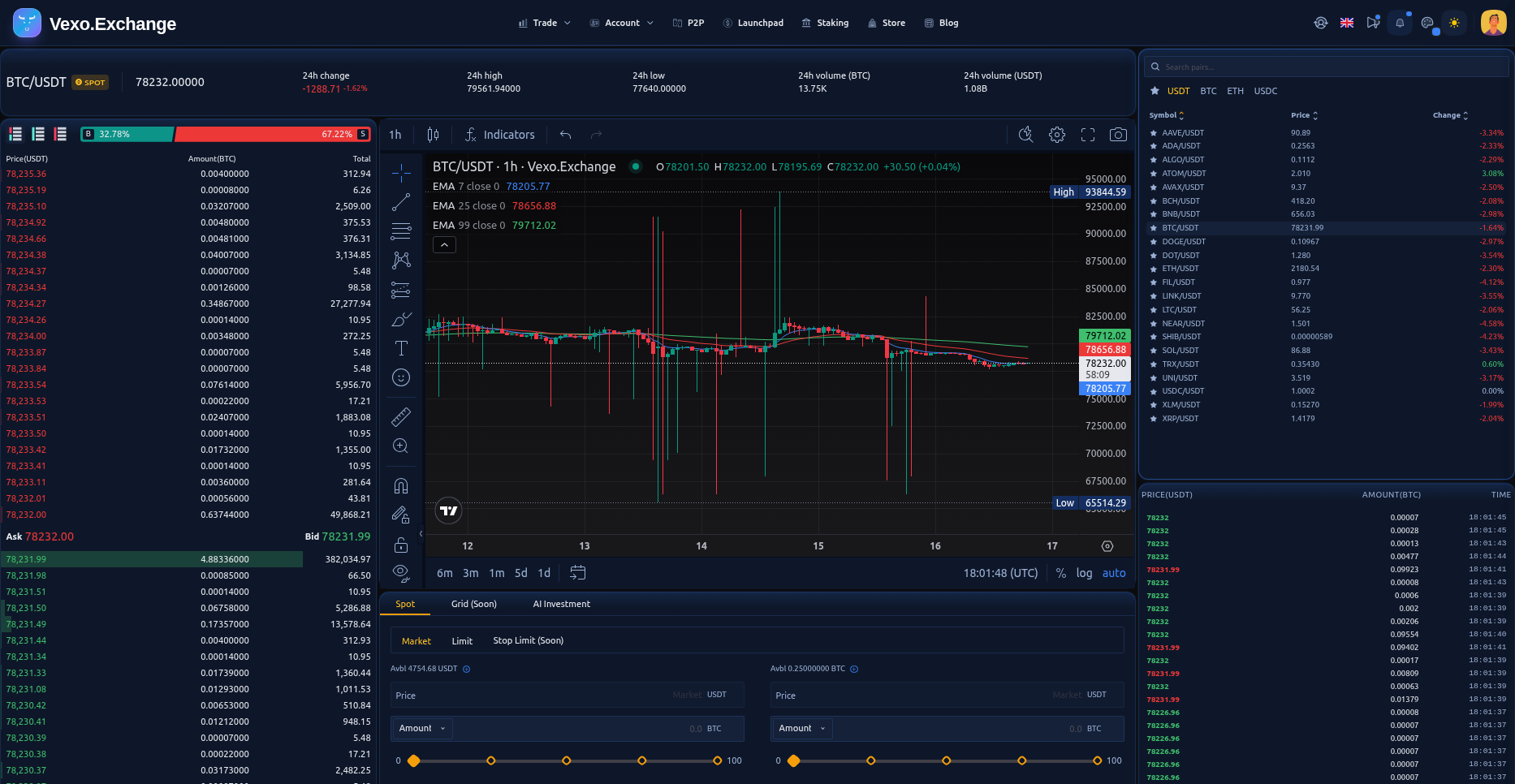
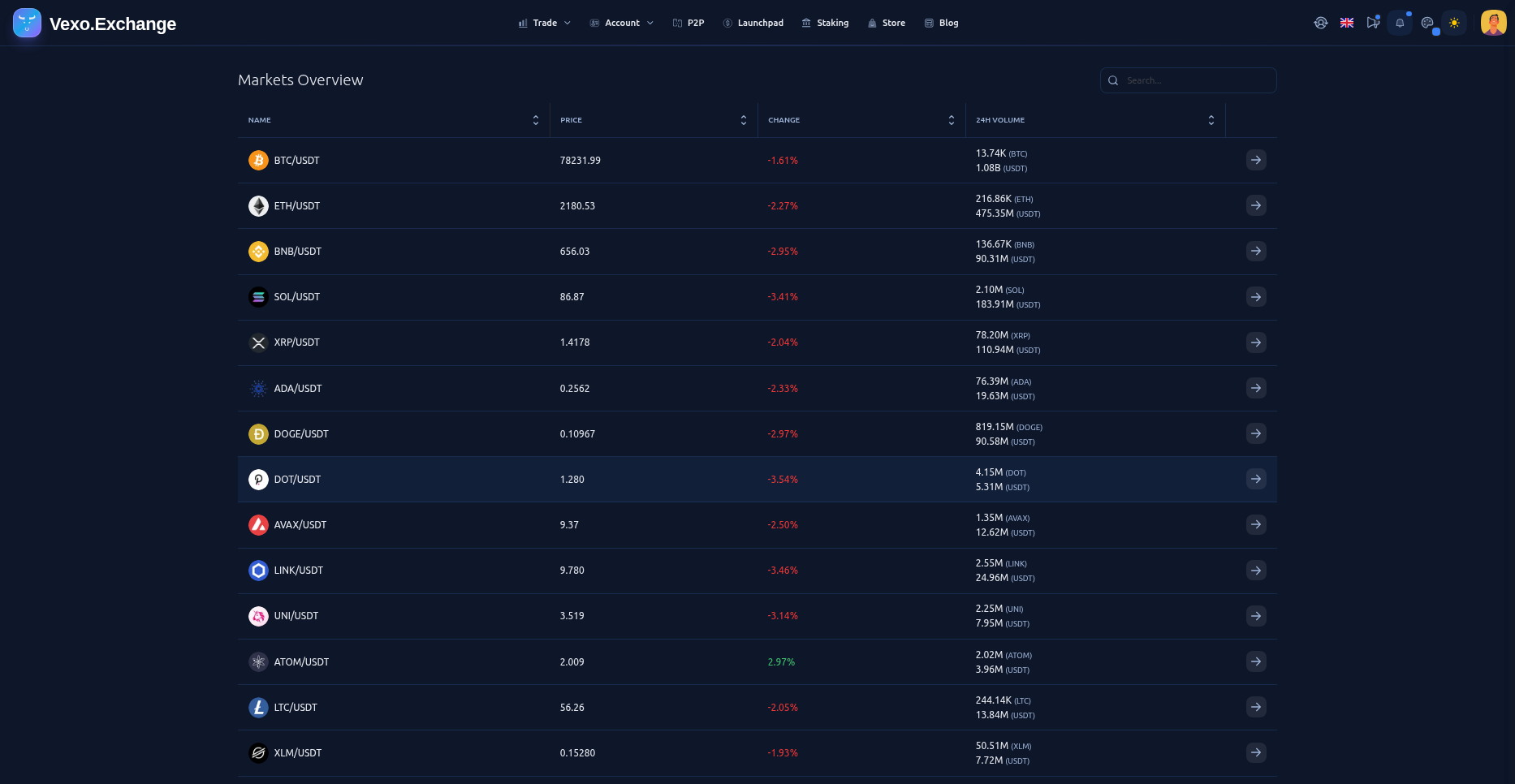
Mercat is our in-house spot trading terminal. It runs on a Rust matching engine — order books are local, fills happen in microseconds, and a liquidity-bridge bot streams Binance depth in to backstop thin markets. The terminal ships with a theme switcher (eight curated palettes); every screenshot in this demo uses Aurora, our institutional default.
◆ Why our own matching engine
White-label exchanges that rebrand Binance or KuCoin endpoints inherit the counterparty risk, the API rate-limits, and the inability to list anything that isn't already on the source venue. Vexo runs its own Rust matching engine — we list what we want, when we want, with fee economics we control. The Binance bridge exists so thin books still feel liquid on day one; it is not the product.
Futures & Derivatives
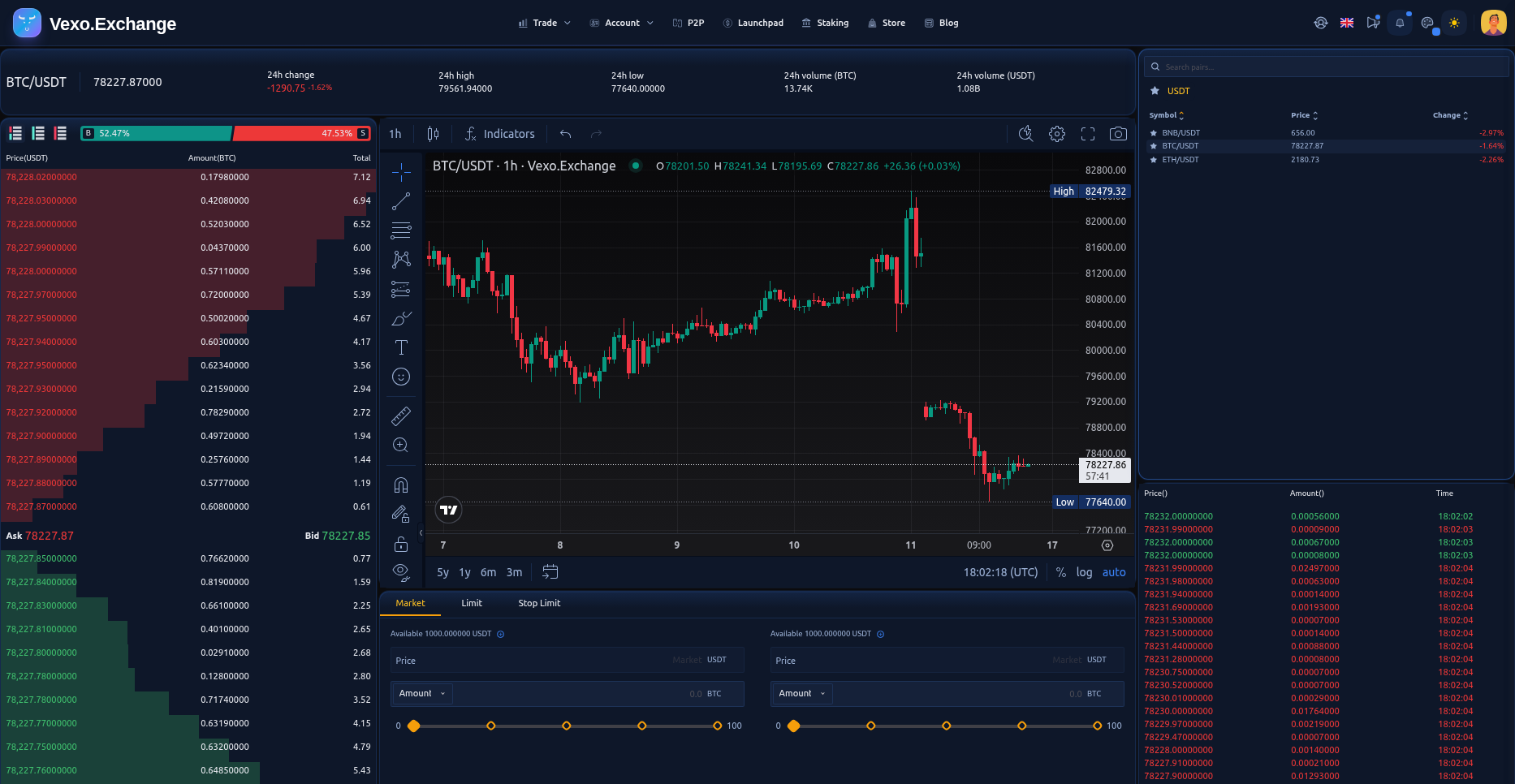
Perpetual futures sit beside spot in the same UI shell — same theme, same order book primitives, same trade history component — so a spot trader can ramp into margin without learning a second product. Leverage, funding rates, liquidation ladders, mark-vs-index price are all surfaced in the ticker; the order form supports market, limit, stop-market and stop-limit out of the box.
P2P Marketplace — the fiat on-ramp
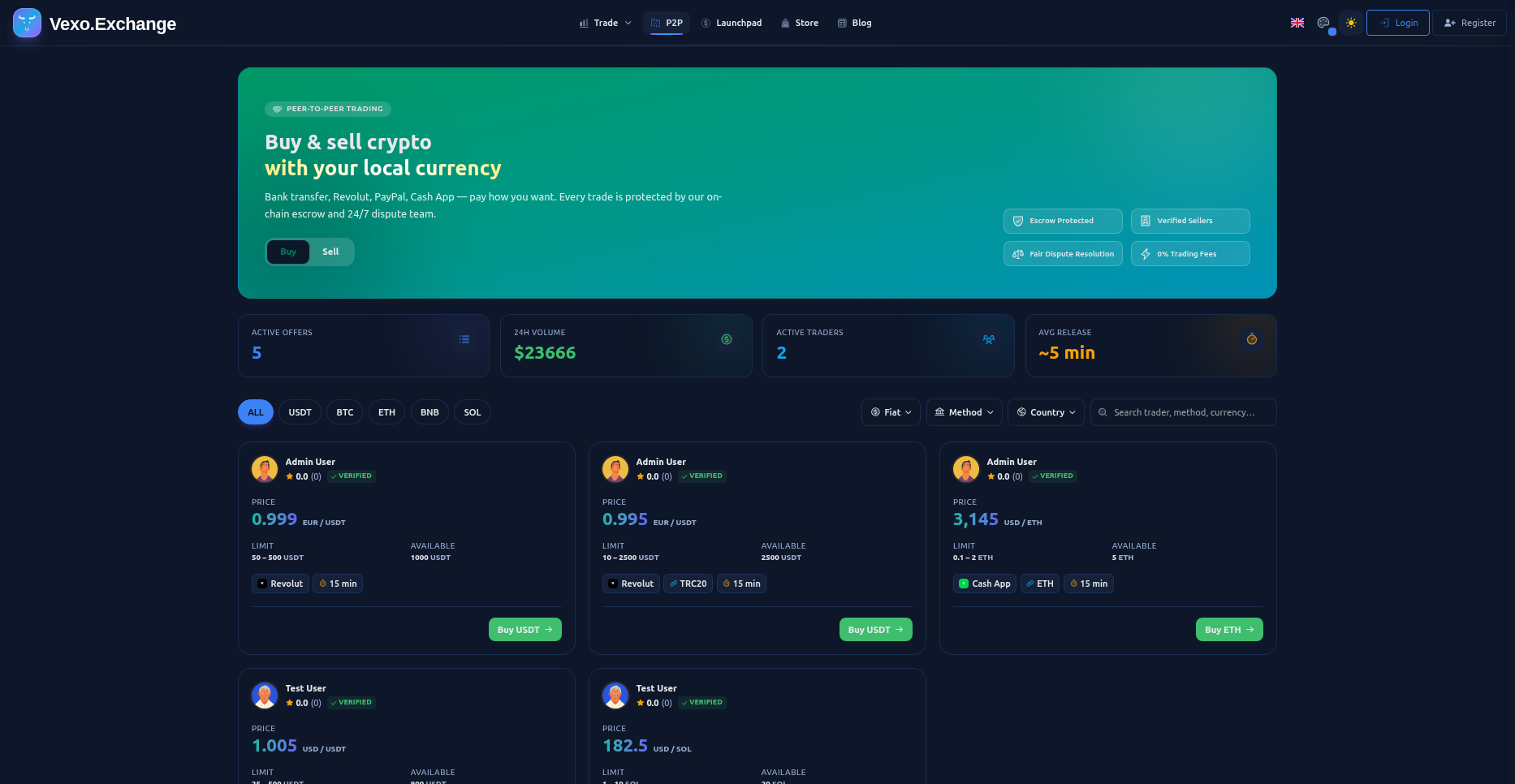
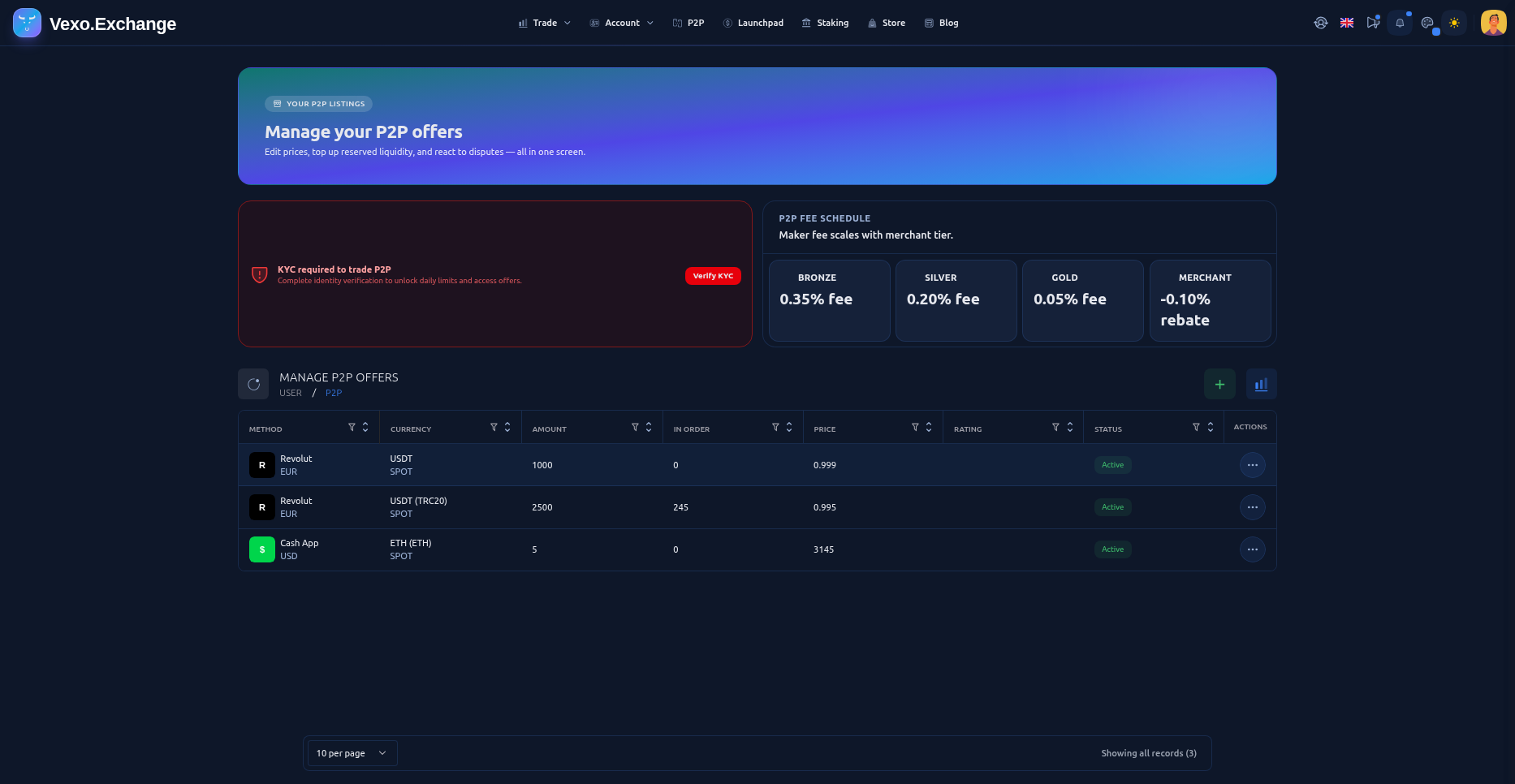
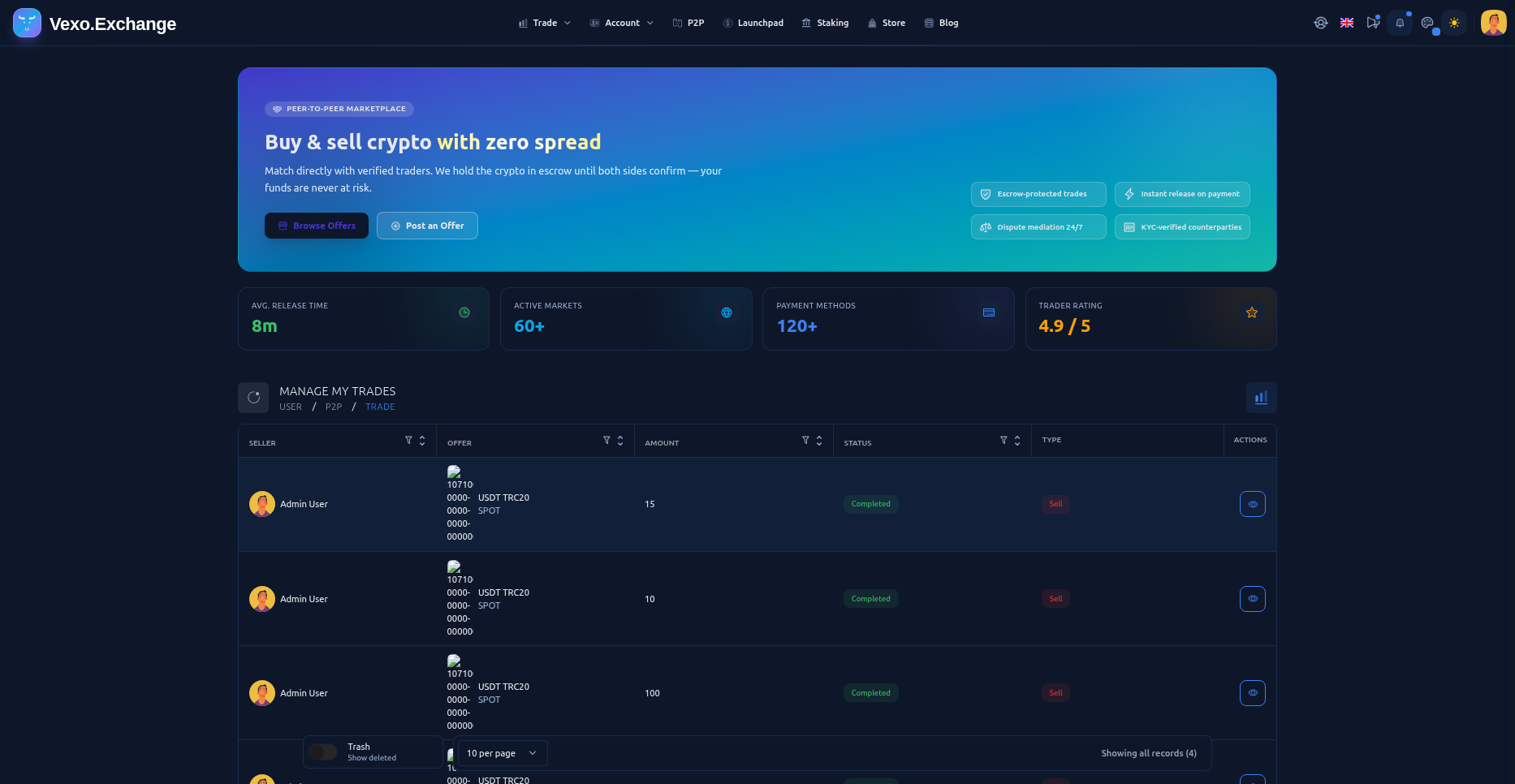
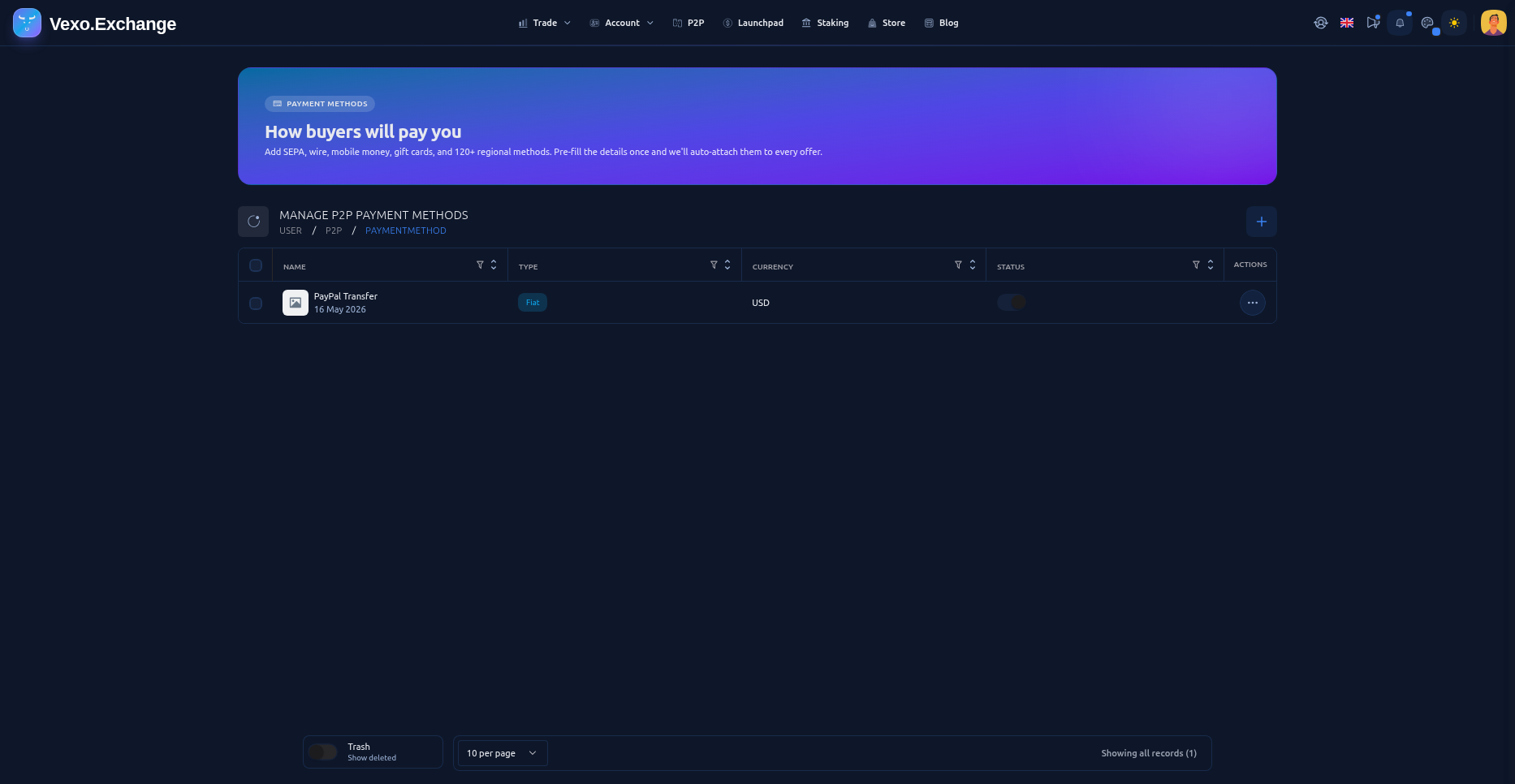
P2P is the cheapest fiat acquisition channel on the planet — and Vexo runs a complete marketplace for it. Users post or accept offers in any supported fiat, pay each other through their preferred local rail (bank transfer, mobile wallet, cash deposit), and the platform escrows the crypto in between. Disputes flow into a moderation queue; payment methods are user-managed; the public catalog is SEO-indexed so each market becomes its own organic traffic surface.
Launchpad — primary issuance
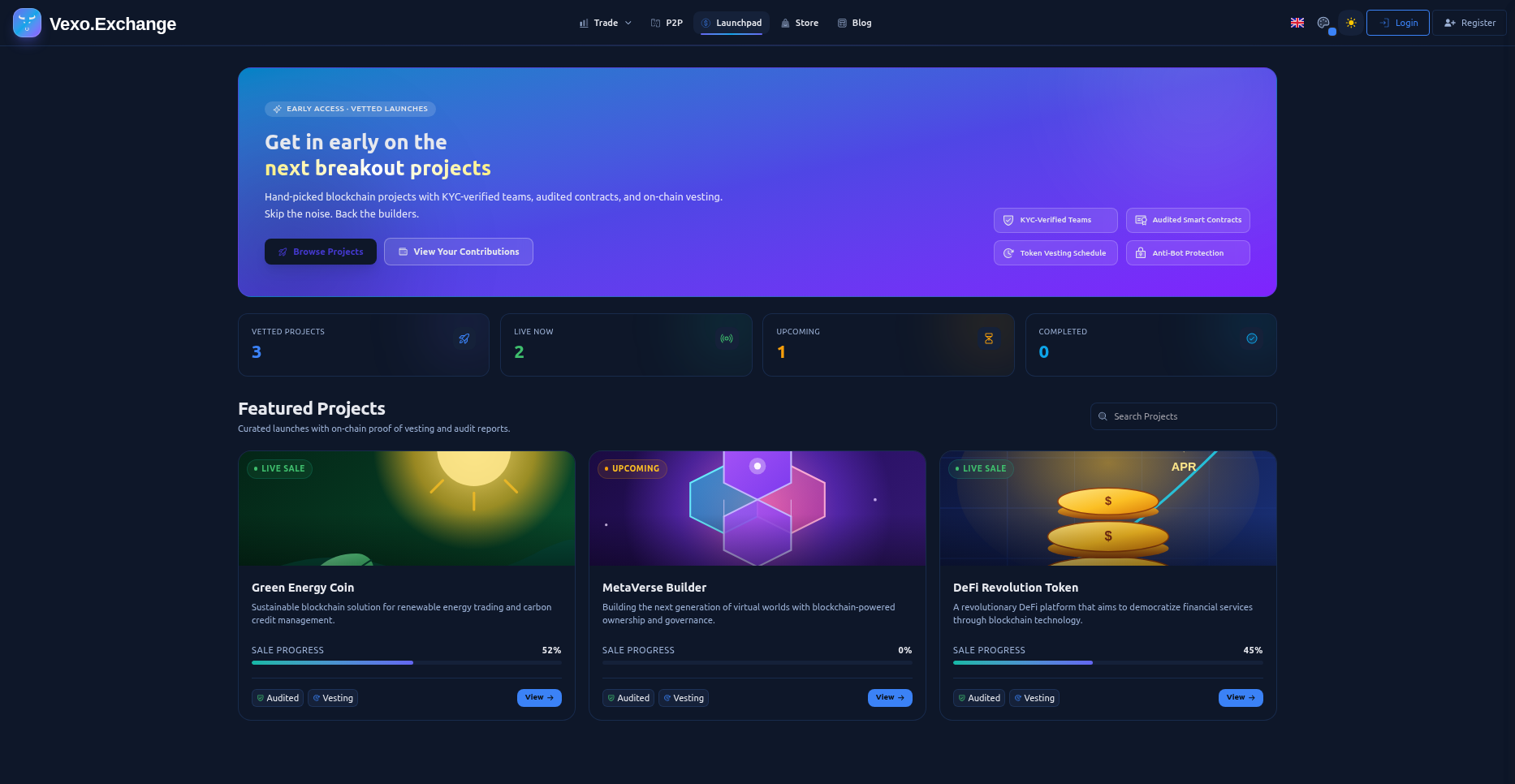
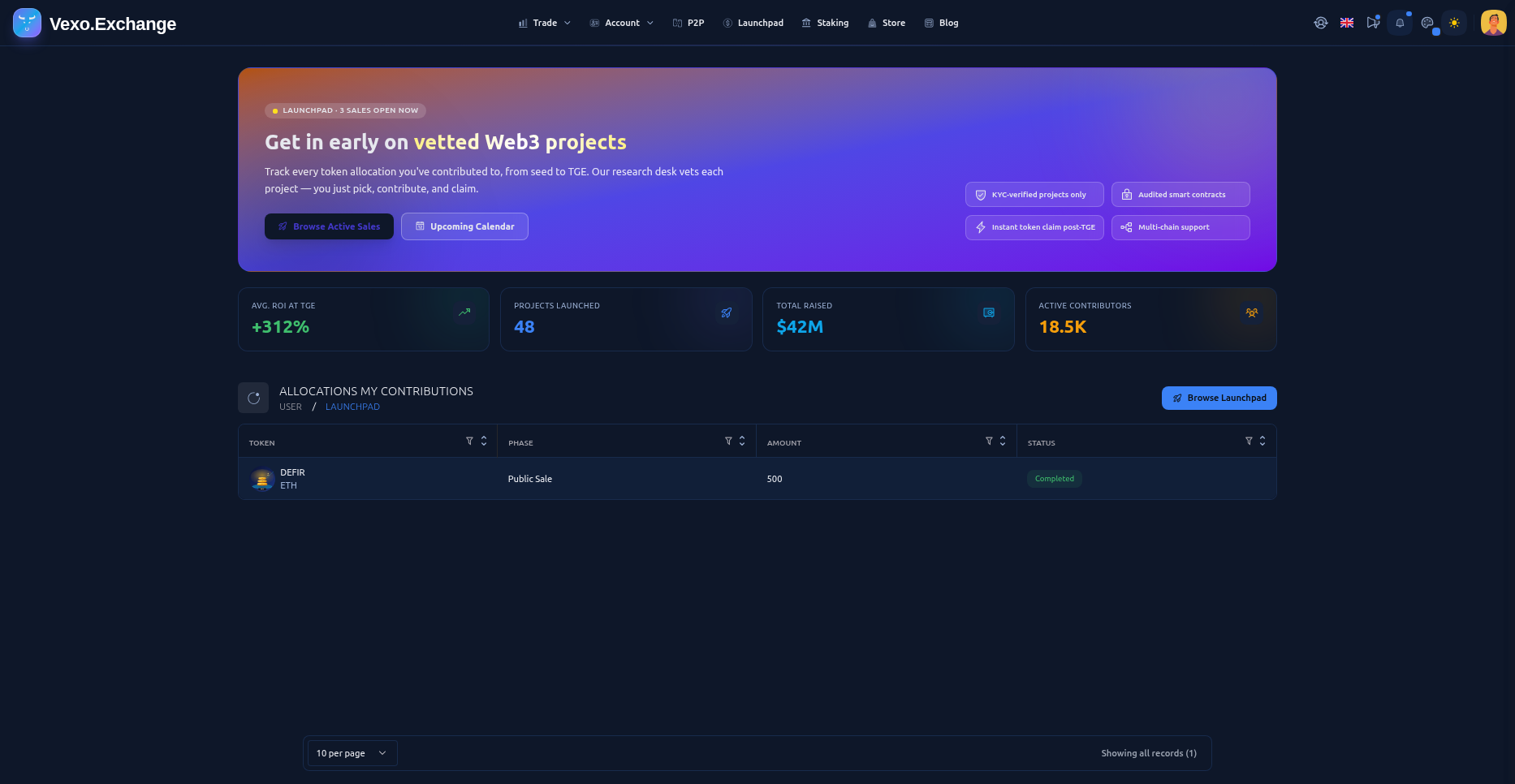
The Vexo Launchpad is where early-stage token issuers meet our user base. Each campaign has its own page, allocation ladder, vesting schedule and KYC tier requirement. From the platform's perspective, Launchpad is a fee-rich, low-frequency, high-margin revenue line — and a perpetual reason for users to keep stablecoin balances on the venue.
Yield — Invest plans & Staking
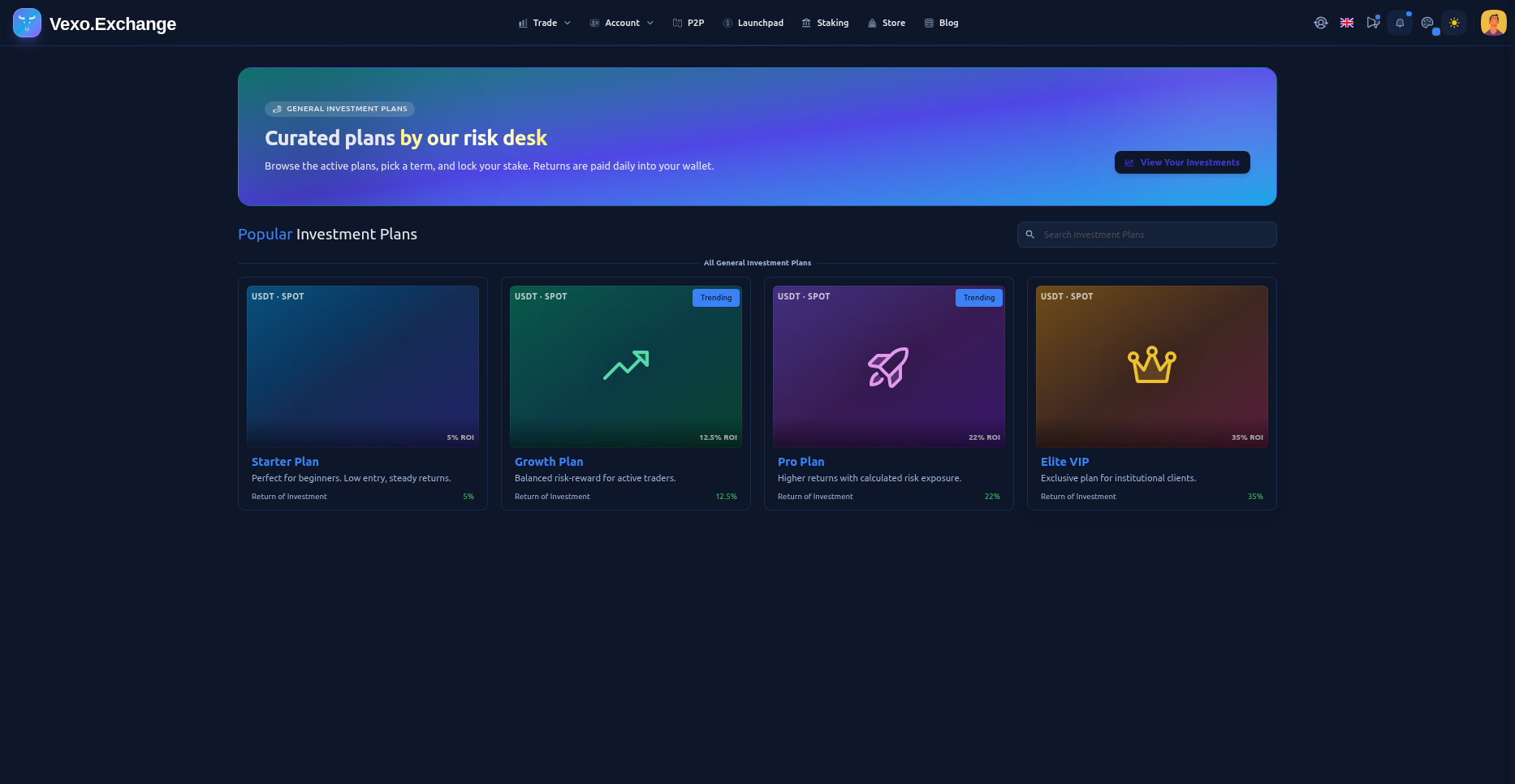
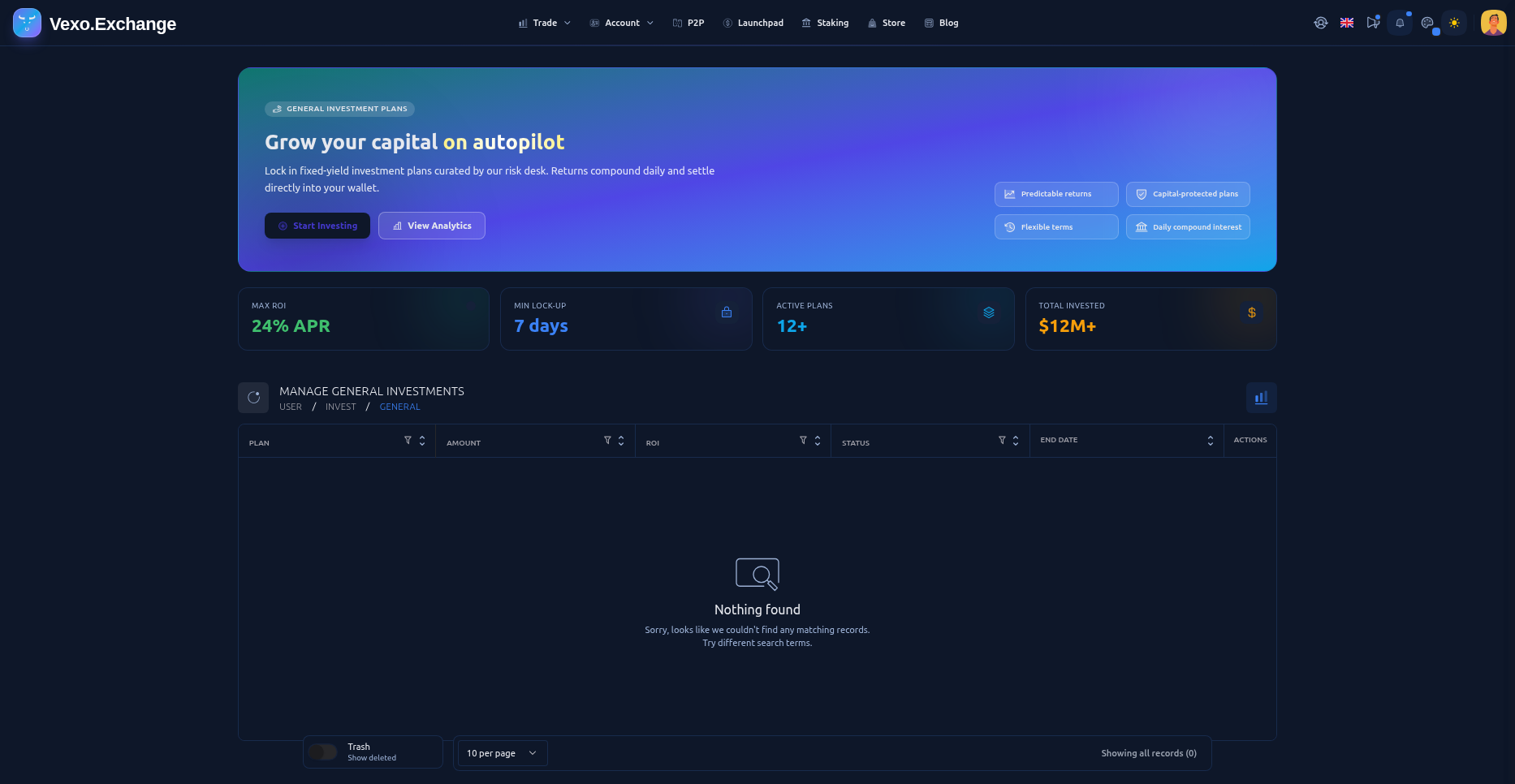
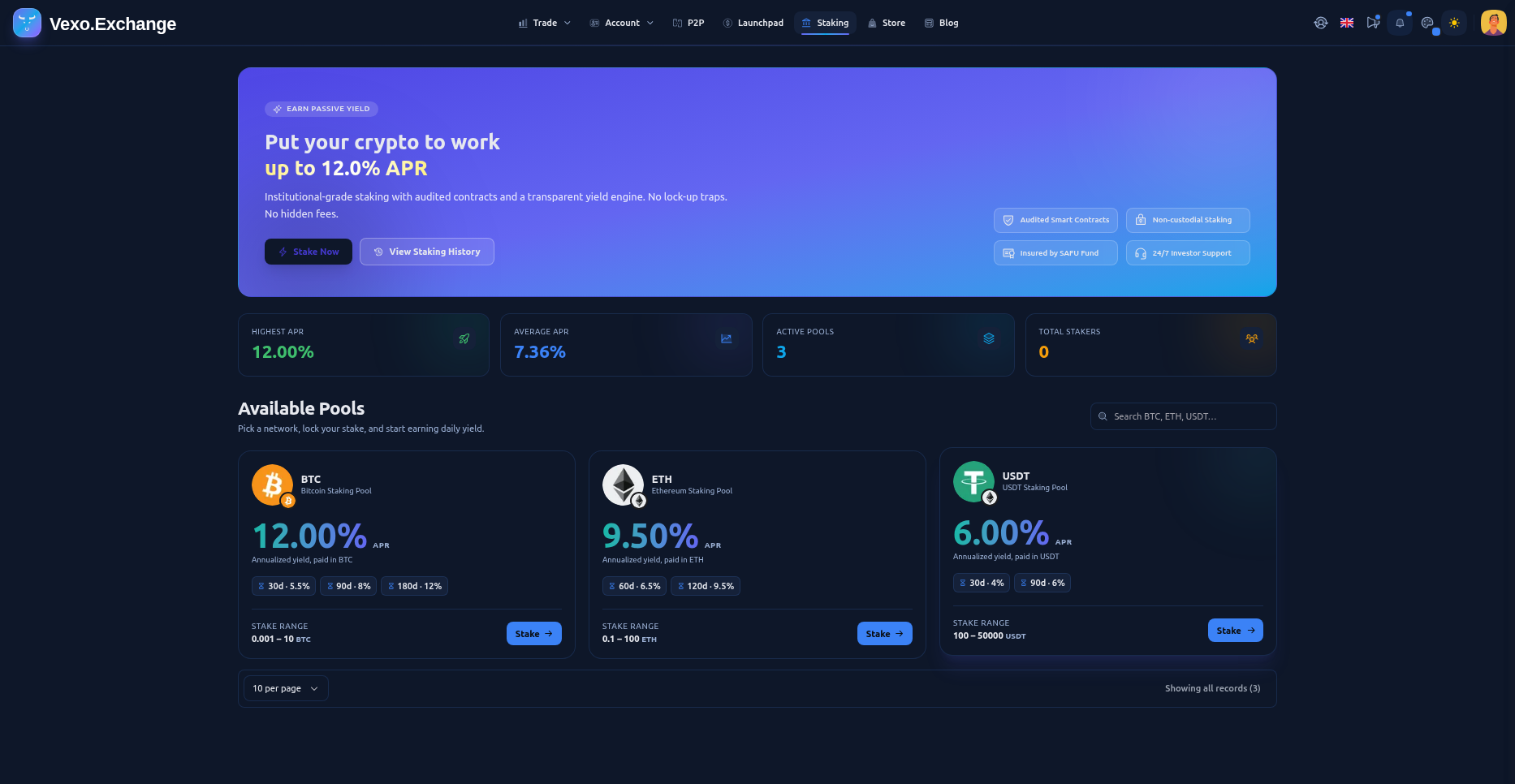
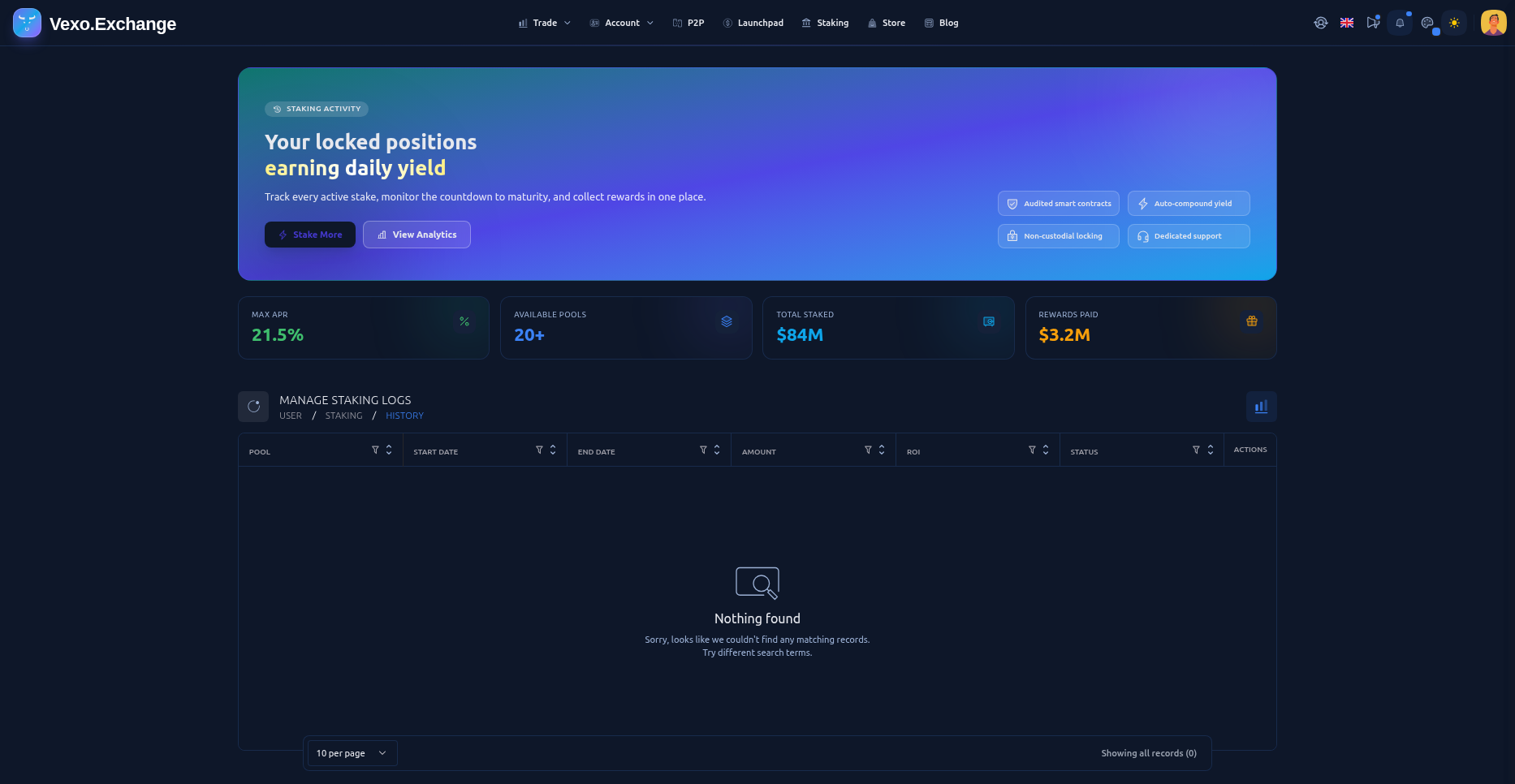
Vexo offers two yield surfaces. Investment Plans are fixed-duration, fixed-APR products — the equivalent of structured deposits. Staking pools are flexible or term-locked positions backed by on-chain validators or platform-internal liquidity. Both share a single accounting backbone and a single user-facing language: commit capital, earn return, exit on schedule.
Affiliate Engine — distribution as a product
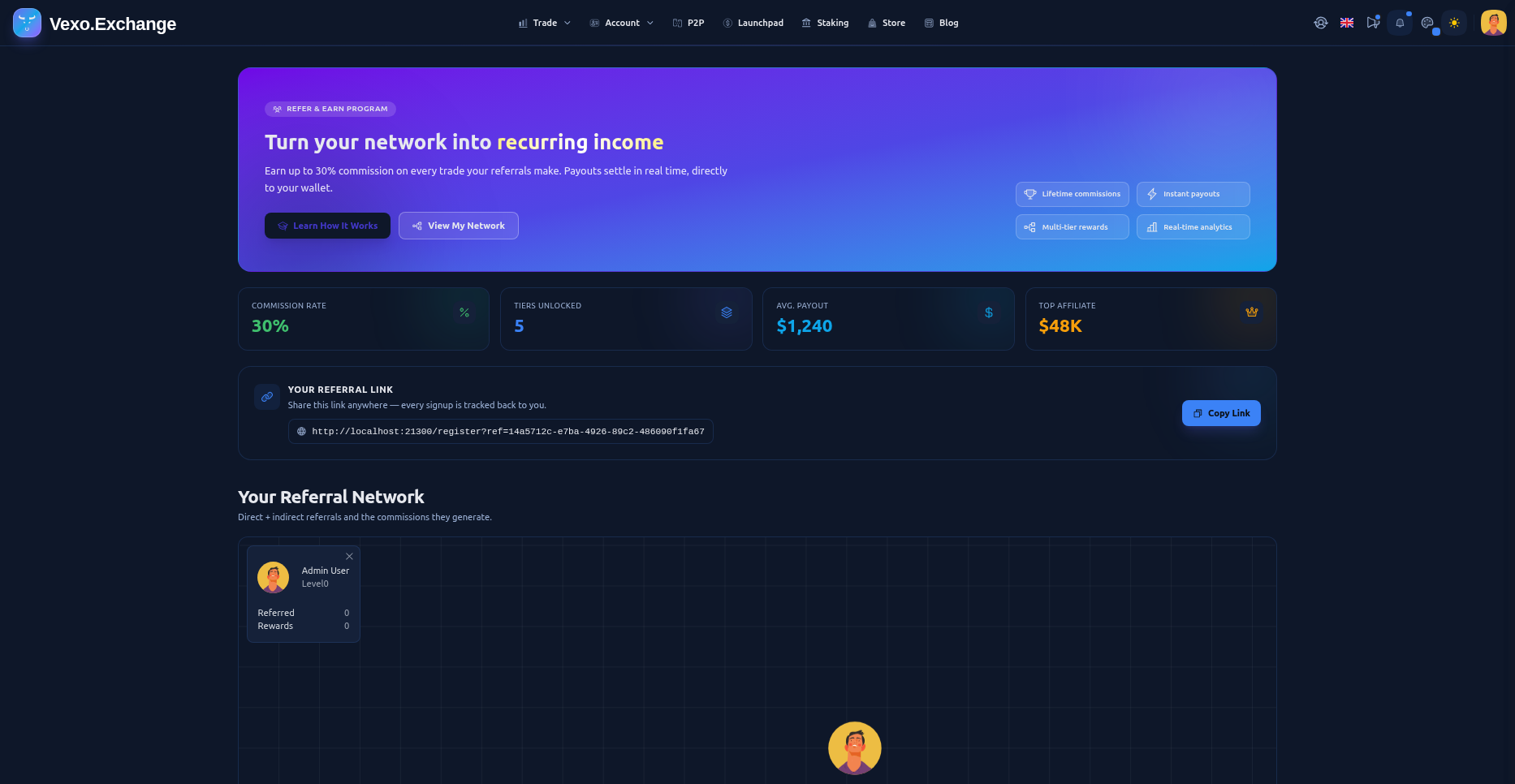
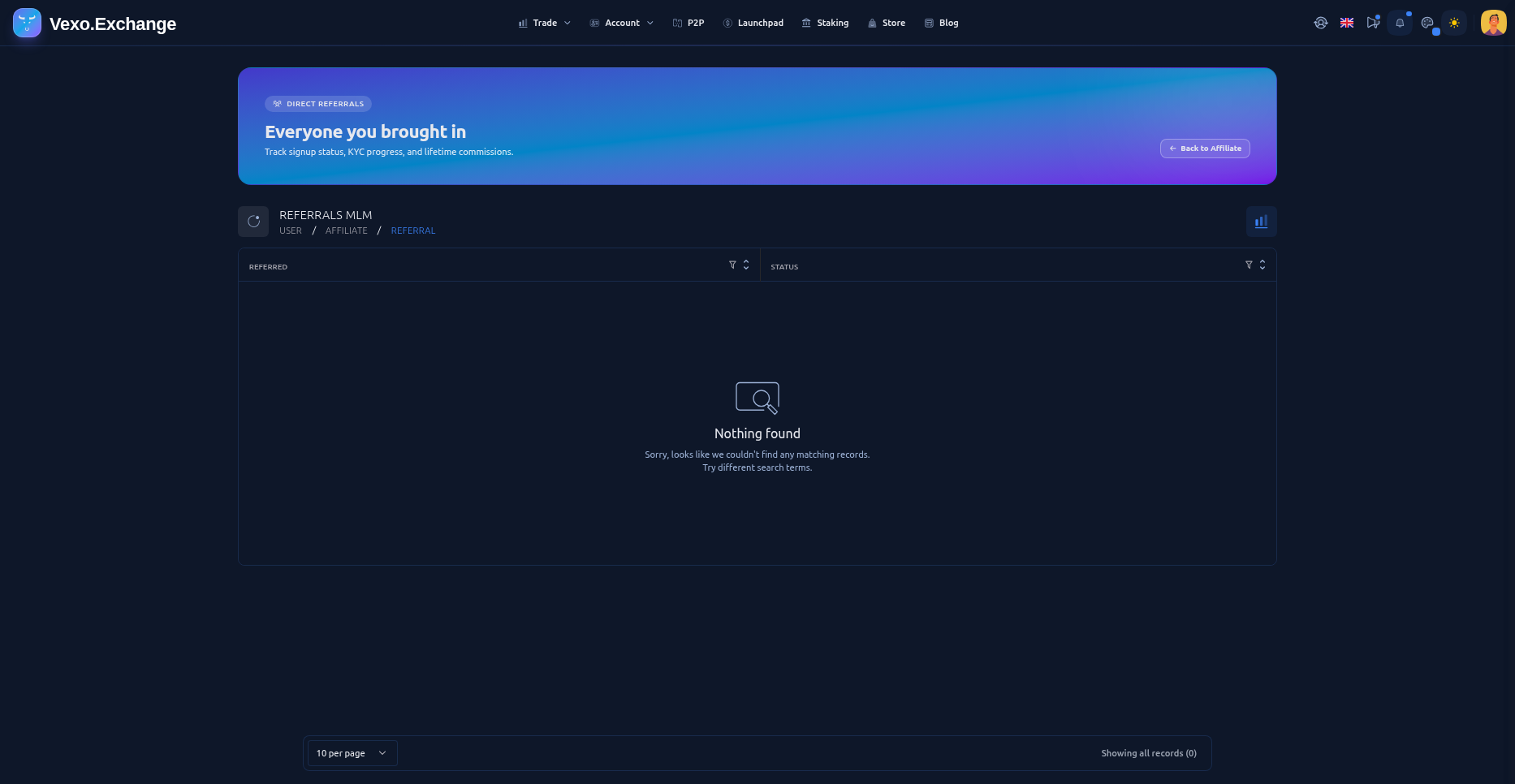
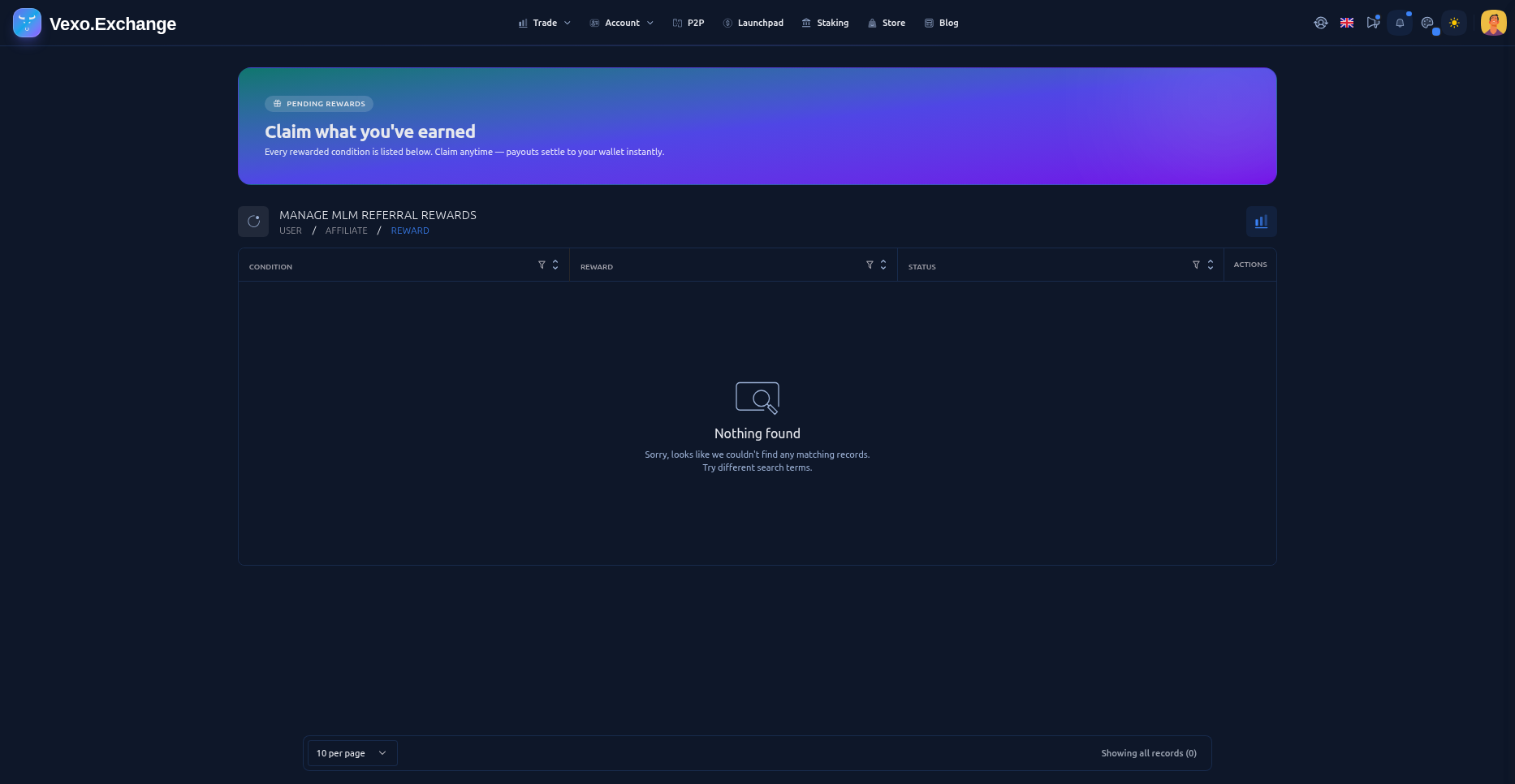
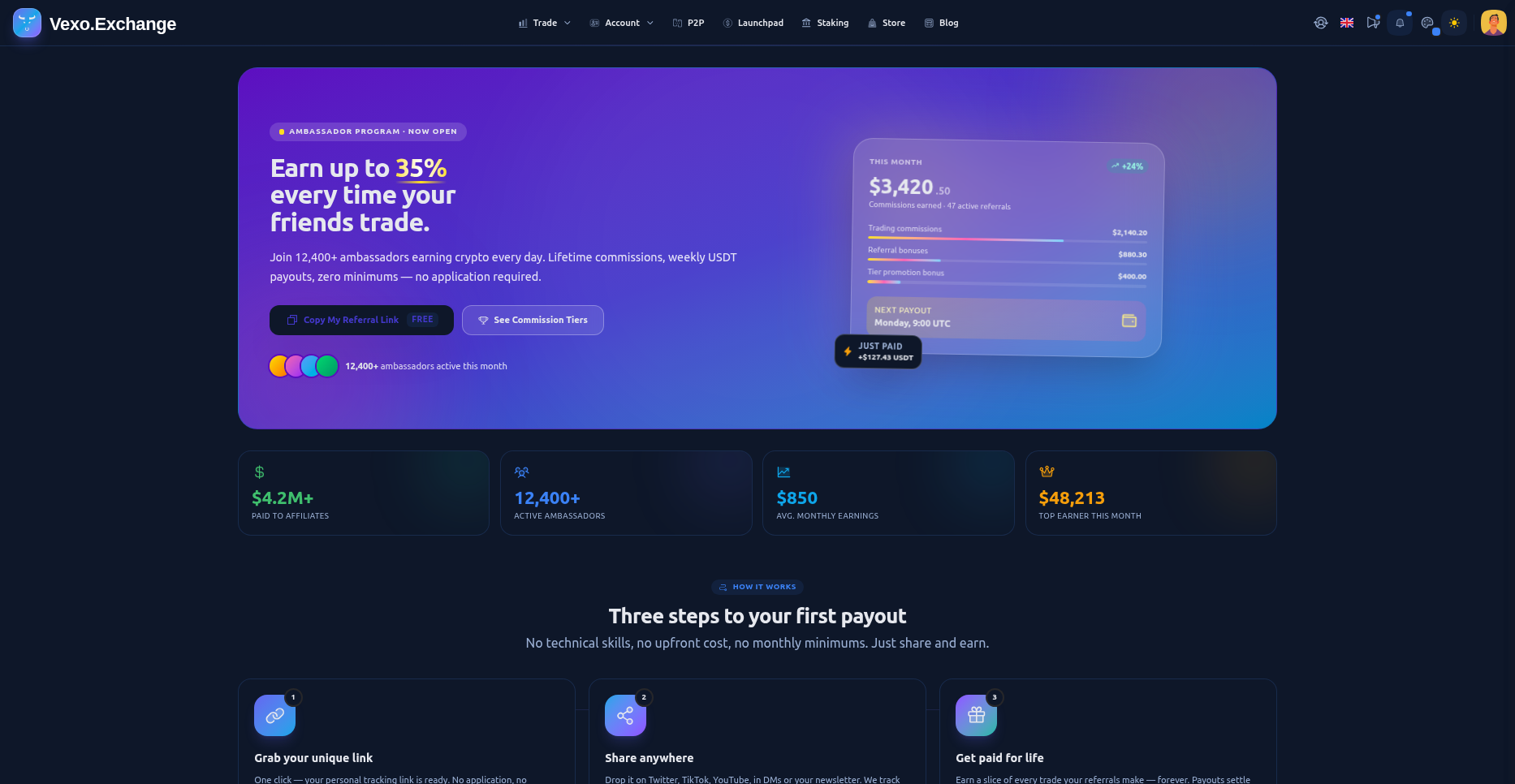
The affiliate program is structured as a multi-level revenue share with explicit metrics. Every referred user is attributed back to a referrer's tree; commissions accrue per-trade and per-deposit; payouts happen on a predictable cadence. Investors should read this section as the answer to "how do you acquire users below ad-network CAC" — by paying users for users.
▲ The acquisition flywheel
CAC is performance-based. Affiliates only earn when the user they brought transacts. There's no upfront ad-spend, no impressions billed for unconverted attention, no agency arbitrage. The economics are durable because they're symmetric — Vexo and the affiliate get paid on the same event.
NFT Marketplace
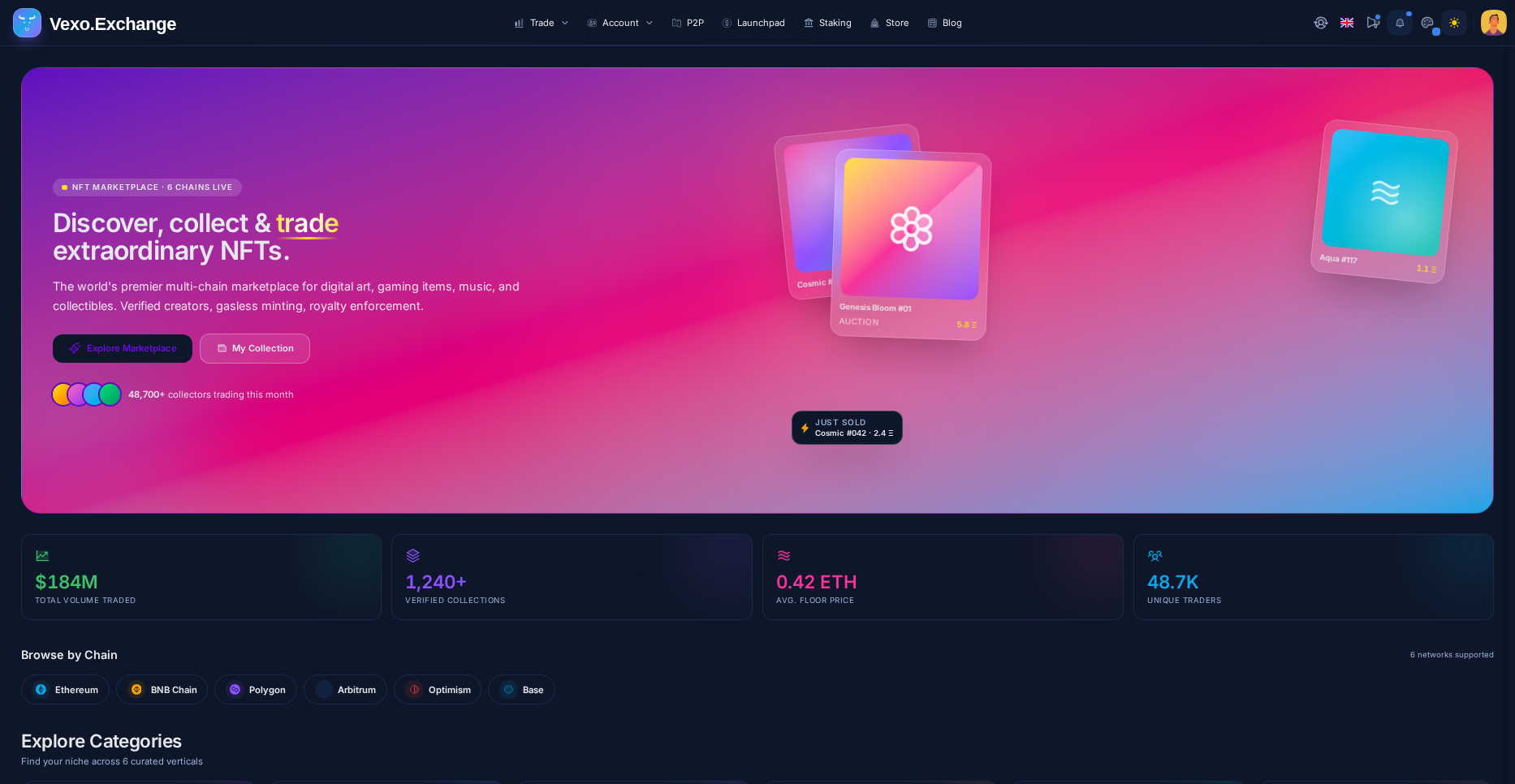
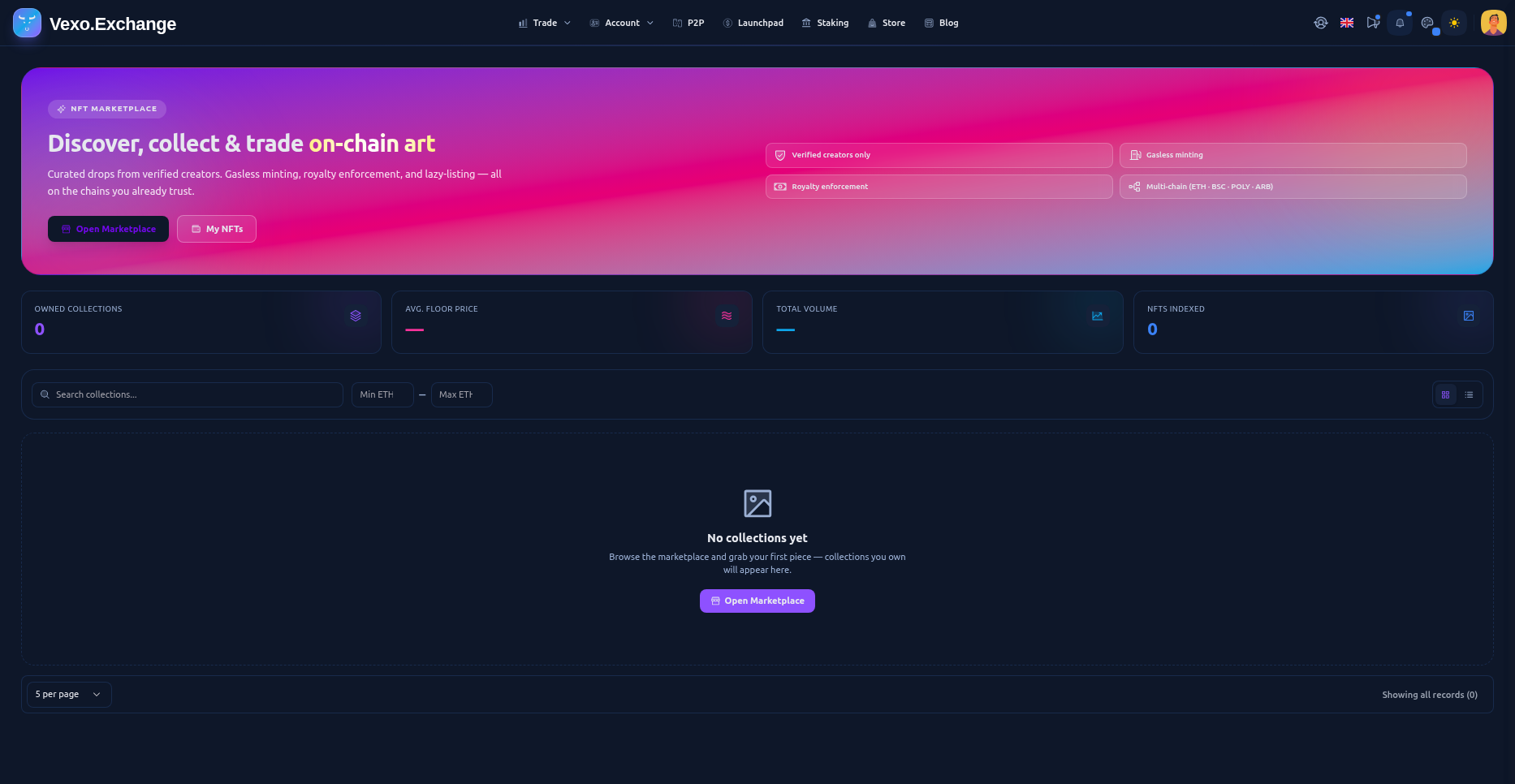
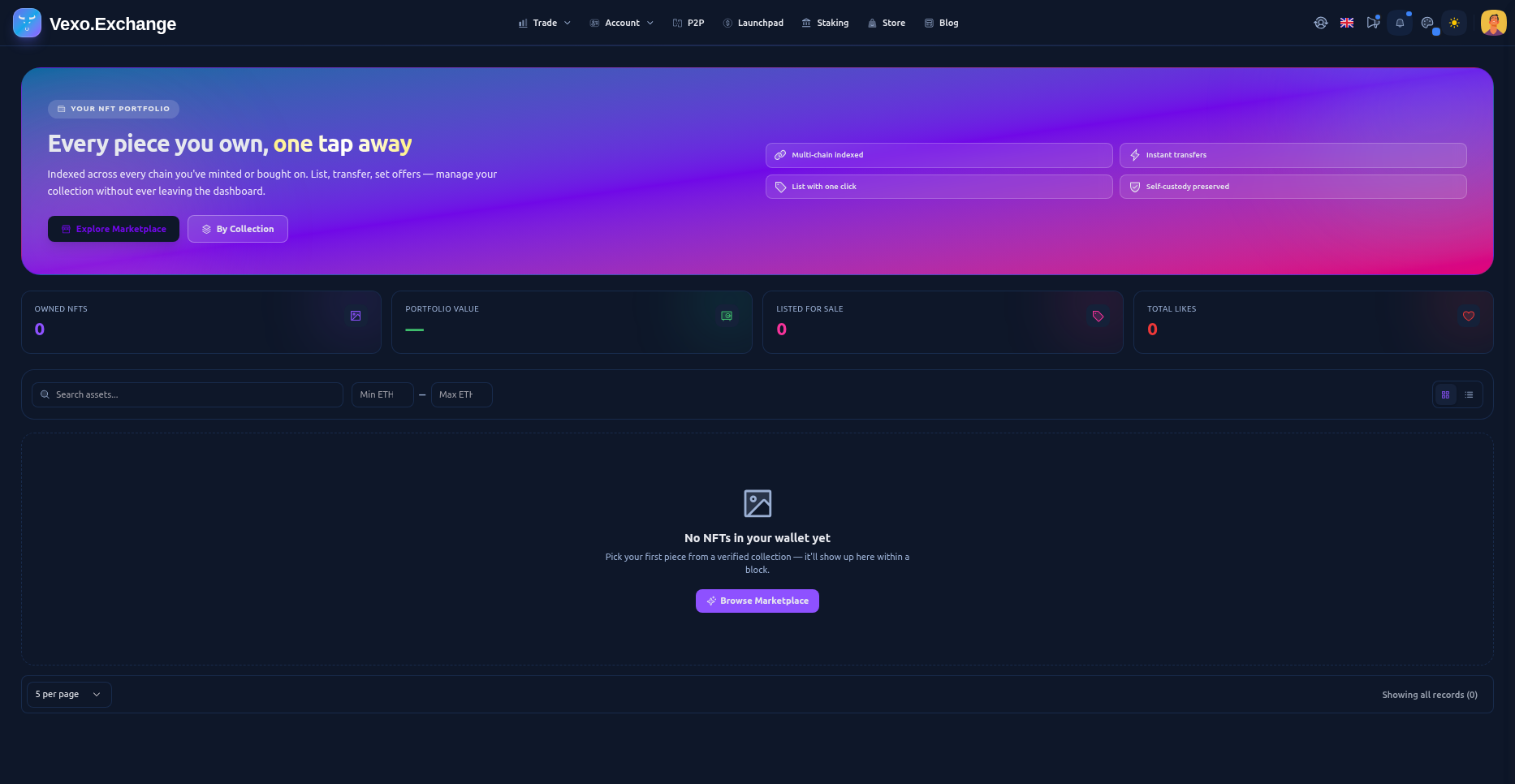
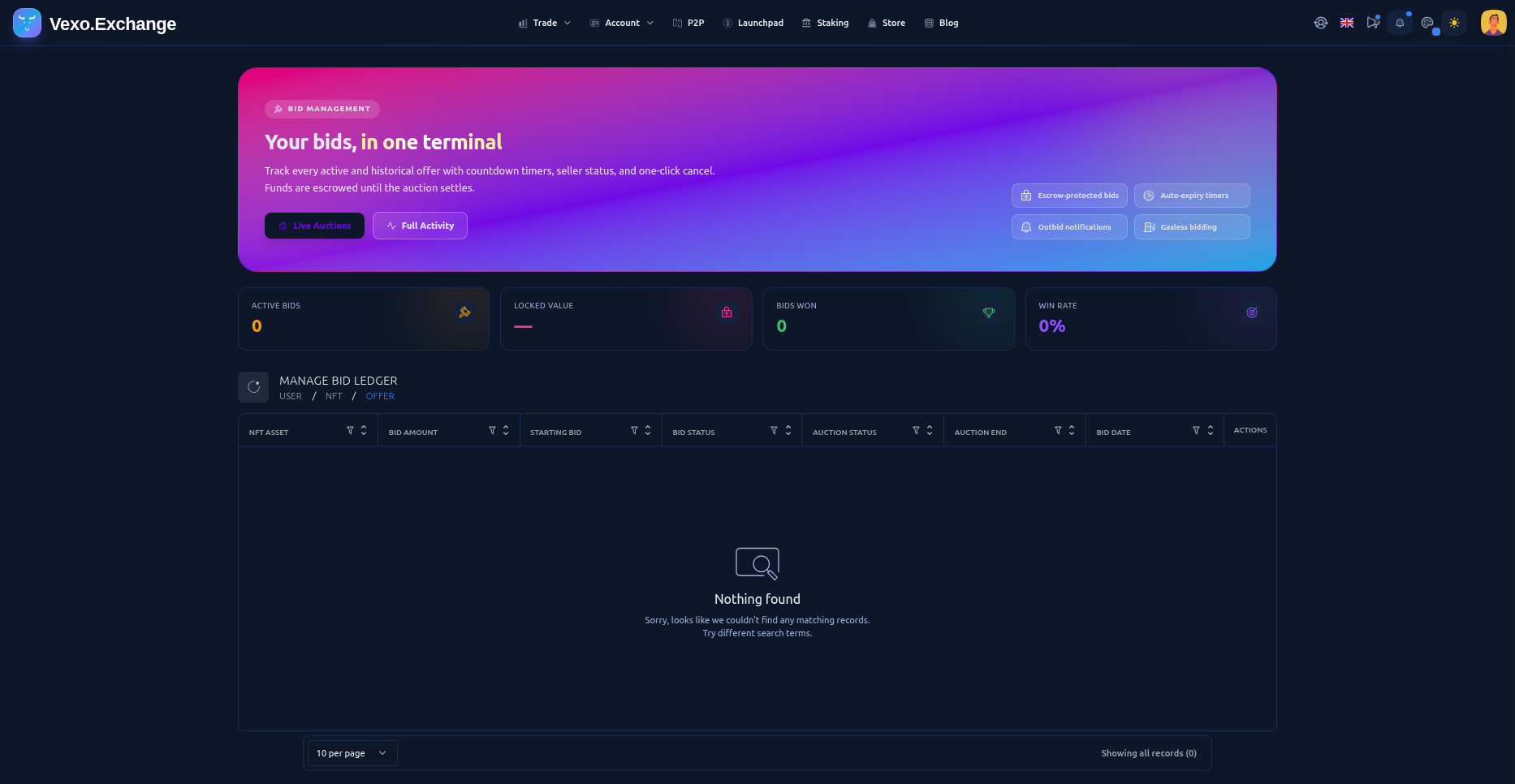
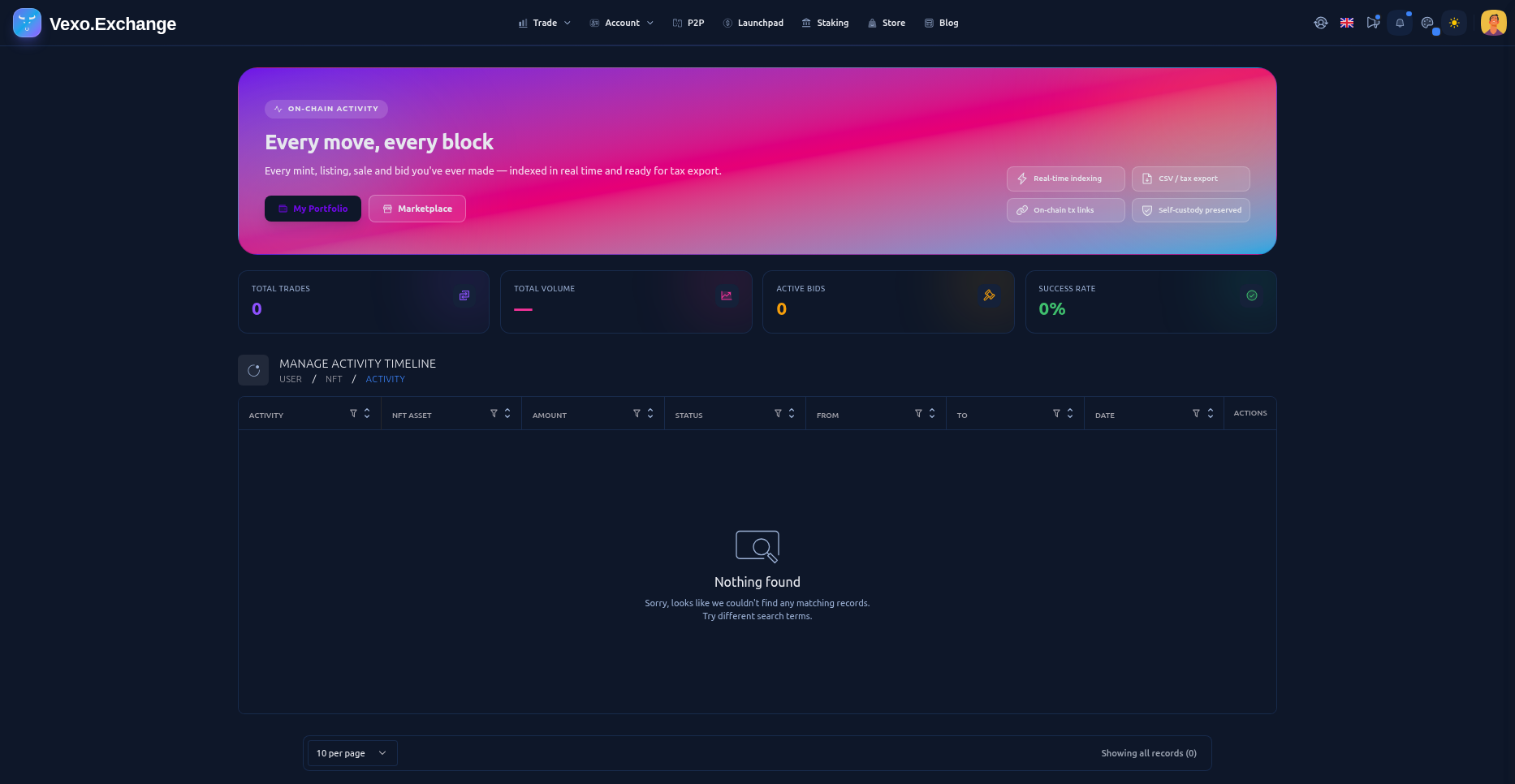
The NFT marketplace covers discovery, collection management, offers and activity timelines. It's not the lead product — it's the optional surface that catches the wallet of users who care about collectibles and want to consolidate them next to their spot balance. Built on the same custody backbone as the rest of the platform.
Binary Options — engineered fair, geo-gated by design
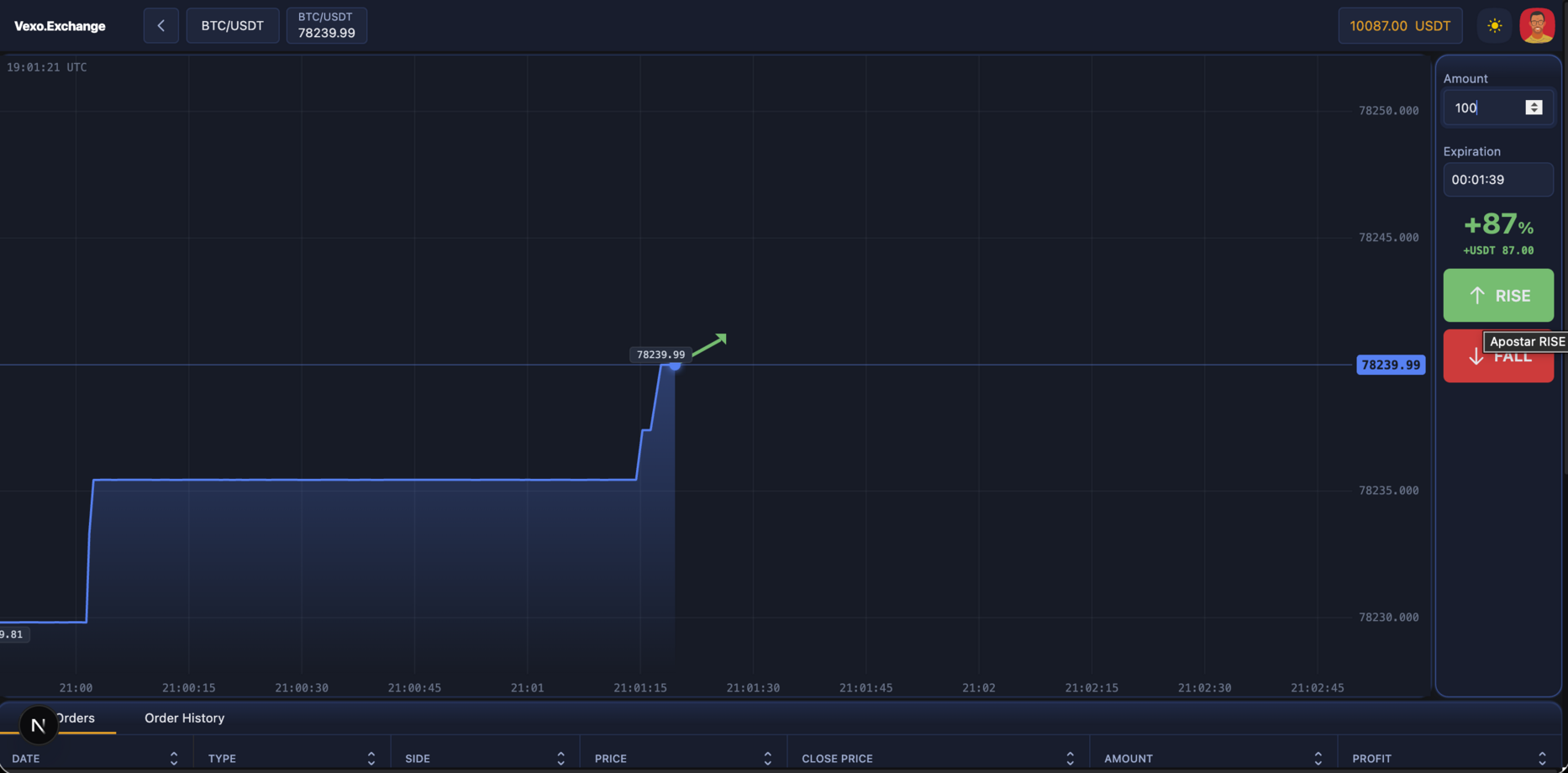
Binary options is one of the highest-margin retail products in crypto — and one of the most abused. Vexo's implementation is the opposite of the rigged white-label clones that dominate the category: three independent tick providers, a dynamic payout that protects both sides of the book, trend-aware circuit breakers, and a geo-gate that only opens in jurisdictions where binaries are legal. We earn margin from a fair book, not from picking the user's pocket.
◆ Three independent tick providers — and the user sees them
Every binary contract is settled against a median tick from three independent price feeds (a tier-1 exchange, a second-tier exchange, and an oracle network). The three feeds are visible inside the trading room — users can see all three quotes side-by-side and watch them converge on the settlement tick. Manipulating one feed costs the manipulator and changes nothing on the contract — the other two carry the median.
Why investors should care: binary's bad reputation comes from operators who quietly nudge the close price to flip a winning bet into a loss. With three feeds shown to the user and the median enforced server-side, we make that class of attack visible and unprofitable.
▲ Dynamic payout balancing — the book pays both sides to stay even
The payout is not fixed; it's a live function of book imbalance:
- The minority side gets a higher payout. If 80% of volume is leaning RISE, FALL bettors are paid more — incentivising the opposite trade and rebalancing the book without manual intervention.
- The majority side gets a lower payout. As one-sided pressure builds, the dominant side's payout compresses — making continued one-way bets less attractive.
- Net effect: the platform's worst-case exposure stays bounded automatically, even when sentiment is heavily skewed. The book is self-balancing the way a market-maker's quotes are.
◆ Trend-aware safety rails
Binaries are most exploitable when the underlying is trending — a strong directional move makes one side a near-certain winner, and naive operators get picked apart. Our engine watches the aggregated tick stream for sustained trend signatures (configurable lookback, configurable threshold) and reacts in three tiers:
- Soft: payout on the trend-aligned side drops further; minority payout climbs.
- Hard: contract size caps on the trend-aligned side.
- Cooling-off: brief pause on new contracts until the trend signature decays.
All three tiers are parameter-driven and per-symbol, so the risk desk can tune BTC differently from a thinner pair without touching code.
▲ Jurisdiction-gated — LATAM, Africa, ASEAN only
Binary options is not enabled globally. The feature is gated by user country and only unlocks in jurisdictions where the product is legal and our operator stack is licensed — currently LATAM, Africa, and ASEAN corridors. Users outside those regions don't see the menu entry, the trading room is unreachable by direct URL, and KYC enforces the geofence at withdrawal.
Why investors should care: the regulatory perimeter is encoded in the product, not in a marketing disclaimer. We grow binaries where we can run them cleanly; we don't take the headline risk of operating where we shouldn't.
Adjacent Surfaces — store, blog, support
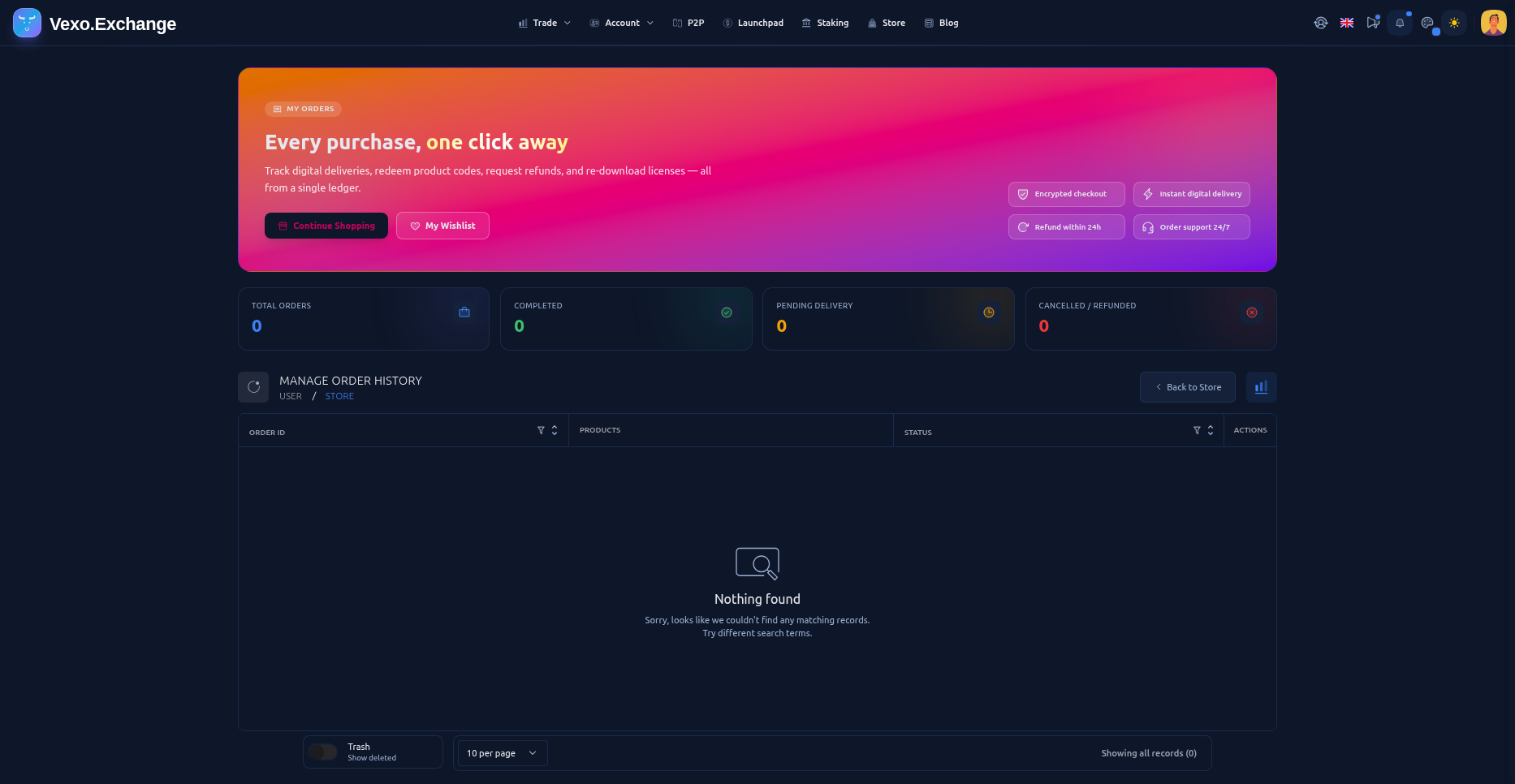
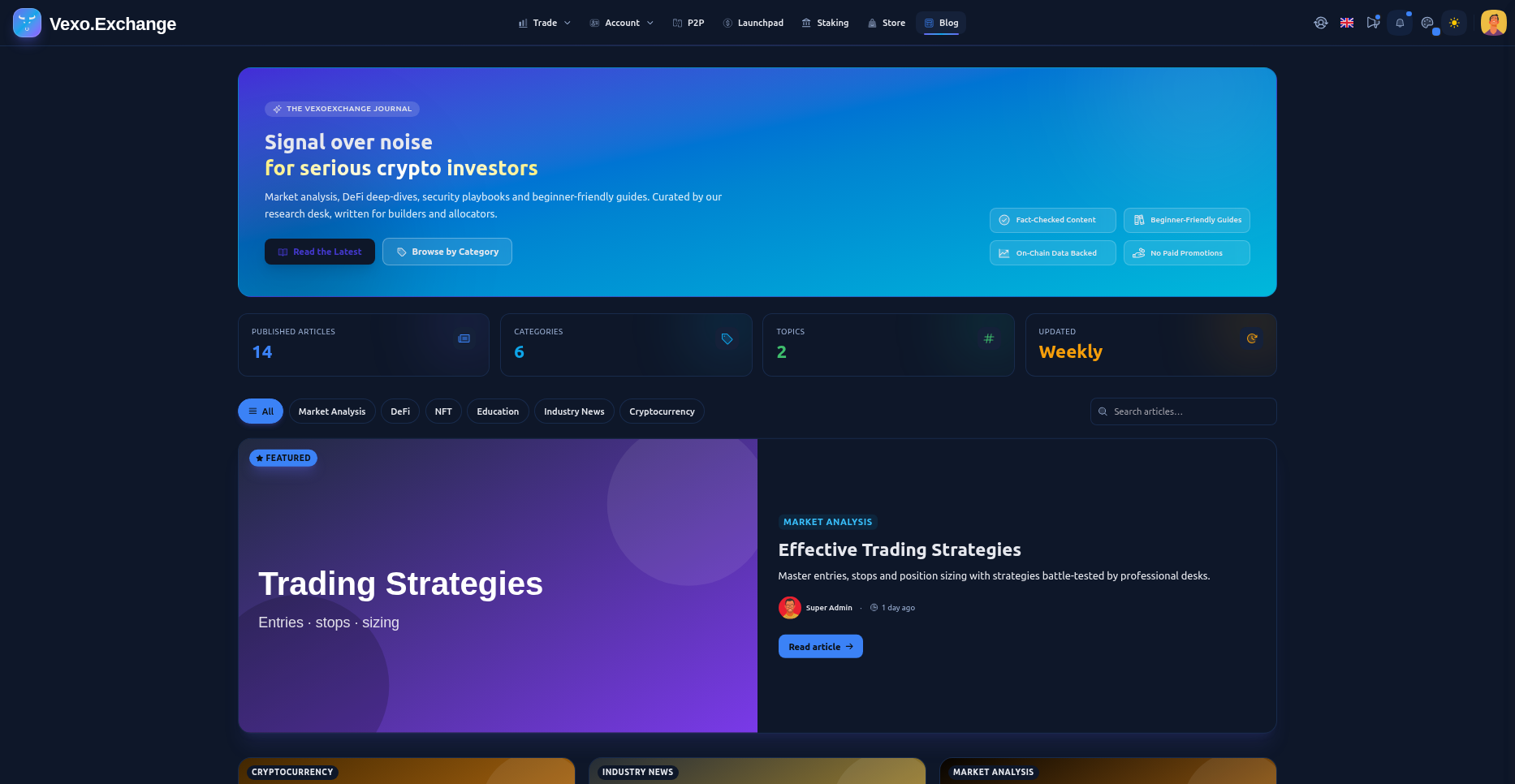
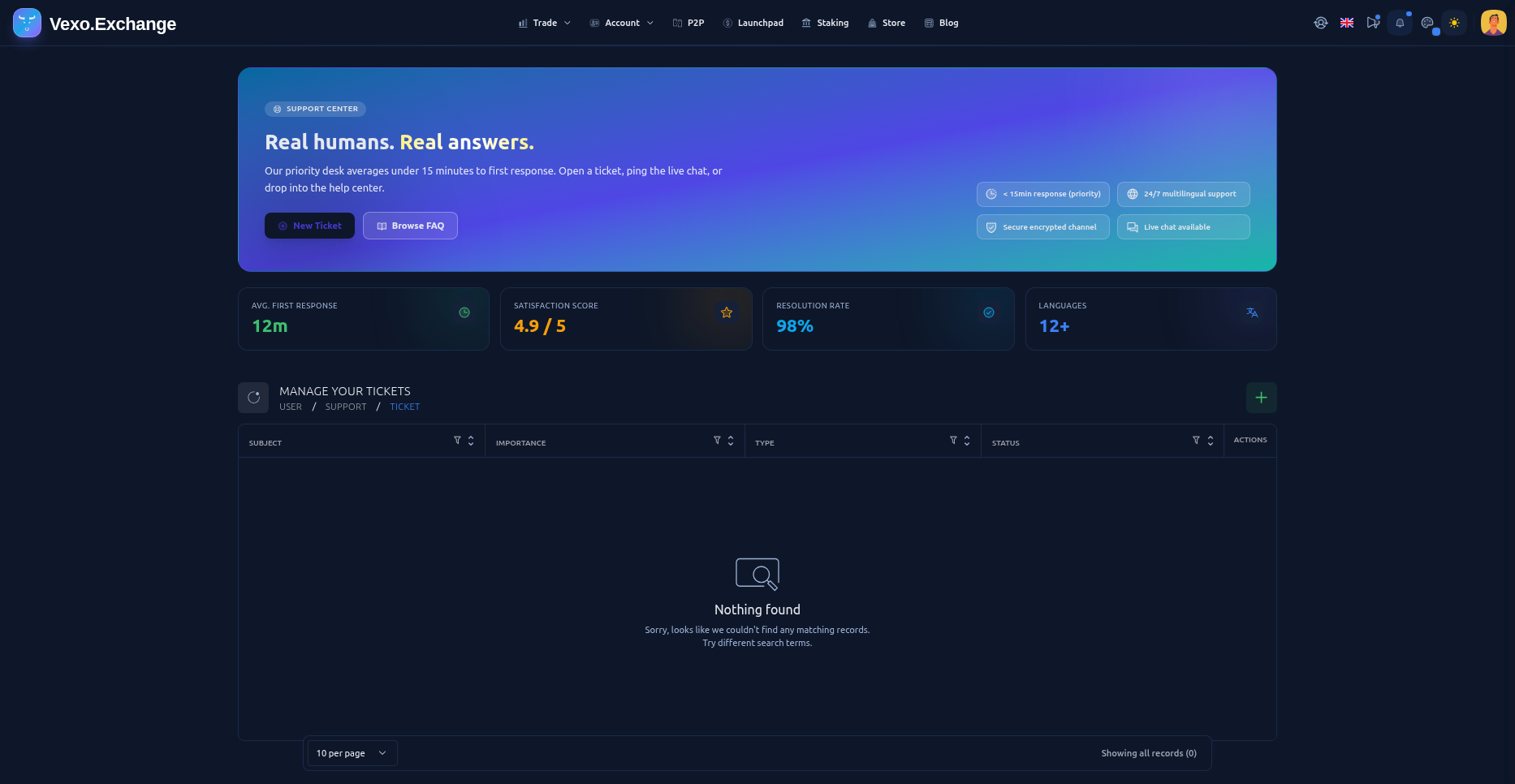
These are the retention and operations surfaces sitting next to the trading core. The store turns merch and partner products into a checkout primitive; the user blog gives trusted authors a publishing console; the ticketing system closes the loop with customer success — every interaction with operations ledgered in one place.
Why now — the investment case
Every screen in this demo is shipping product, not concept. The backbone is a Rust matching engine we control end to end. Each module above is already a revenue line — and each one feeds the others through a shared wallet, a shared identity, and a shared affiliate graph. What follows is the short version of why this is a particularly good entry point.
◆ A multi-product venue at single-product cost
Most exchange teams scale headcount linearly with surface area — one team per product line, one operations org per region. Vexo's architecture is the opposite: one shell, one custody backbone, one identity layer, one matching engine. Adding the next product (perps options, structured notes, prediction markets) is a route and a database table — not a rebuild.
▲ User economics that compound
A single account funds spot, futures, P2P, staking, invest, NFT and launchpad from the same balance. Every new product line multiplies LTV against the same acquisition cost. The affiliate engine flips the CAC equation — distribution is rewarded out of margin Vexo only earns when the user transacts.
◆ Defensible engineering
- Rust matching engine — microsecond fills, in-house, not a white-label.
- Multi-chain ECO custody — segmented per purpose; we don't custody trades through a third-party.
- Liquidity bridge to Binance — backstops thin order books so users always see depth.
- Theme manifest + TradingView bridge — eight curated palettes, every chart, panel, popup and toolbar paints from the same source of truth (this demo is captured under "Aurora").
- Mobile + desktop wallet — Tauri 2 desktop and React Native 0.83/Expo 55 — proprietary clients shipping next to the web product.
▲ Distribution unlocked, day one
P2P is the cheapest fiat-acquisition channel in the world. It generates organic search traffic per market (e.g. "buy USDT with Pix"), it converts unbanked users at zero card-network cost, and the escrow primitive doubles as the trust signal that closes the deal. We don't run paid ads to grow the P2P book — the SEO surface does that work.
Pair that with the affiliate engine and you have an acquisition model where both the channel and the user pay for themselves on first transaction.
◆ The capital ask
We're raising to accelerate three things: deeper liquidity bridges (more venues, tighter spreads), market expansion into the next five fiat corridors (LATAM & SEA), and the perpetual-options product that closes the derivatives gap against the top-tier venues. Every dollar that comes in funds either a revenue-line operator or the engineering bench that backs them.
What you've seen here is the surface. The platform is already operating. The conversation we'd like to have is about scale.